X 2 36

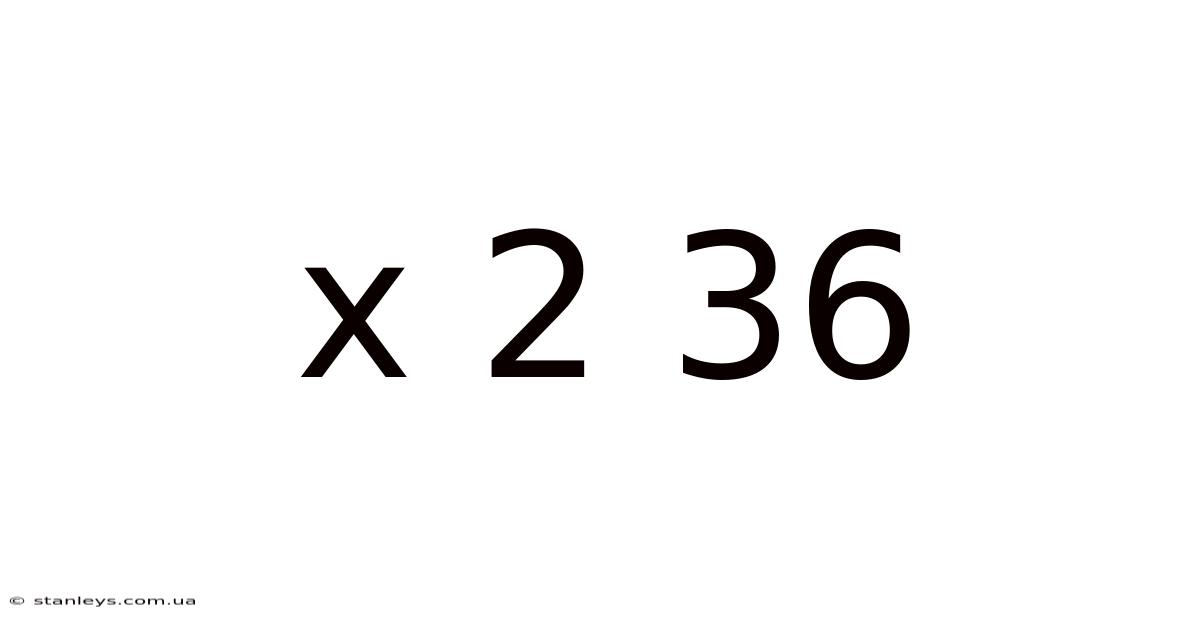
Decoding x² + 36: A Deep Dive into Quadratic Expressions and Their Solutions
This article explores the quadratic expression x² + 36, examining its properties, potential solutions, and the broader mathematical concepts it represents. Understanding this seemingly simple expression unlocks a deeper appreciation for quadratic equations, complex numbers, and their applications in various fields. We'll cover the basics, delve into more advanced concepts, and address frequently asked questions to provide a comprehensive understanding.
Introduction: Understanding Quadratic Expressions
A quadratic expression is a polynomial of degree two, meaning the highest power of the variable (usually 'x') is 2. The general form is ax² + bx + c, where a, b, and c are constants, and 'a' is not equal to zero. Our focus, x² + 36, is a special case where b = 0 and c = 36. This simplification allows us to explore some fundamental concepts more clearly. This expression is crucial in understanding various mathematical operations, from simple factoring to more complex concepts like complex numbers. Mastering its intricacies is a cornerstone of algebraic proficiency.
Exploring the Equation x² + 36 = 0
To truly understand x² + 36, let's consider the equation x² + 36 = 0. This equation asks: "What value of 'x', when squared, equals -36?" This seemingly simple question leads us down a path involving complex numbers.
Why Standard Factoring Doesn't Work
In standard algebra, we often factor quadratic expressions to find their roots (the values of x that make the expression equal to zero). However, x² + 36 doesn't factor neatly using real numbers. There are no two real numbers that, when multiplied, equal 36 and, when added, equal 0. This is because the expression represents a parabola that doesn't intersect the x-axis (meaning it has no real roots).
Introducing Complex Numbers: The Solution
To solve x² + 36 = 0, we need to venture into the realm of complex numbers. Complex numbers are numbers of the form a + bi, where 'a' and 'b' are real numbers, and 'i' is the imaginary unit, defined as the square root of -1 (√-1).
Here's how we solve for x:
-
Isolate x²: Subtract 36 from both sides of the equation: x² = -36
-
Take the square root: Taking the square root of both sides gives x = ±√(-36)
-
Introduce the imaginary unit: Since the square root of a negative number is not a real number, we introduce 'i': x = ±√(36)√(-1) = ±6i
Therefore, the solutions to x² + 36 = 0 are x = 6i and x = -6i. These are complex conjugate pairs, a common feature when solving quadratic equations with no real roots.
Graphical Representation and Parabolas
The equation y = x² + 36 represents a parabola that opens upwards. Since the parabola's vertex is at (0, 36) and it opens upwards, it never intersects the x-axis. This visually confirms that there are no real roots, reinforcing our earlier findings using complex numbers. The graph helps visualize the absence of real solutions, providing a geometrical interpretation of the algebraic results.
The Significance of Complex Conjugates
The fact that the solutions are complex conjugates (6i and -6i) is not accidental. This is a fundamental property of quadratic equations with real coefficients. If a quadratic equation with real coefficients has complex roots, they always come in conjugate pairs. This property has significant implications in various areas of mathematics and its applications.
Further Applications and Extensions
The exploration of x² + 36 goes beyond simply finding its roots. It serves as a building block for understanding more complex mathematical concepts:
-
Polynomial Division: x² + 36 can be used as a divisor in polynomial long division. Understanding how to perform this division is fundamental to factoring higher-degree polynomials.
-
Partial Fraction Decomposition: In calculus, decomposing rational functions into simpler fractions often involves quadratic expressions like x² + 36 in the denominator.
-
Complex Number Arithmetic: Working with x² + 36 strengthens skills in complex number arithmetic, including addition, subtraction, multiplication, and division of complex numbers.
-
Trigonometry and Polar Coordinates: Complex numbers can be represented in polar form (using magnitude and angle), which is particularly useful in trigonometry and solving certain types of equations.
-
Advanced Algebra and Linear Algebra: The understanding of quadratic expressions and their roots forms a foundation for more advanced algebraic concepts, such as eigenvalues and eigenvectors in linear algebra. These concepts have widespread applications in physics, engineering, and computer science.
Frequently Asked Questions (FAQ)
-
Q: Can x² + 36 be factored using real numbers?
A: No. There are no two real numbers that multiply to 36 and add to 0.
-
Q: What does it mean if a quadratic equation has no real roots?
A: It means the parabola represented by the equation doesn't intersect the x-axis. The solutions are complex numbers.
-
Q: Why are complex conjugates important?
A: They are a fundamental property of quadratic equations with real coefficients. If a quadratic equation with real coefficients has complex roots, they always appear as conjugate pairs (a + bi and a - bi).
-
Q: How are complex numbers used in real-world applications?
A: Complex numbers have significant applications in various fields, including electrical engineering (AC circuit analysis), quantum mechanics (wave functions), signal processing, and fluid dynamics.
-
Q: Is there a way to visualize complex roots graphically?
A: While not directly on the real x-y plane, complex roots can be visualized using the complex plane (where the x-axis represents real numbers and the y-axis represents imaginary numbers). Each complex number is represented as a point on this plane.
Conclusion: The Enduring Relevance of x² + 36
While seemingly simple, the expression x² + 36 offers a profound introduction to several crucial mathematical concepts. Its unsolvability within the realm of real numbers necessitates the introduction of complex numbers, highlighting their importance and expanding our understanding of the number system. The exploration of this expression provides a solid foundation for further mathematical studies, emphasizing the interconnectedness of various algebraic concepts and their application in diverse scientific and engineering disciplines. Understanding x² + 36 isn't just about solving an equation; it's about unlocking a deeper appreciation for the beauty and power of mathematics. The journey from a simple quadratic expression to the complexities of the complex plane underscores the ever-evolving and fascinating nature of mathematical discovery.
