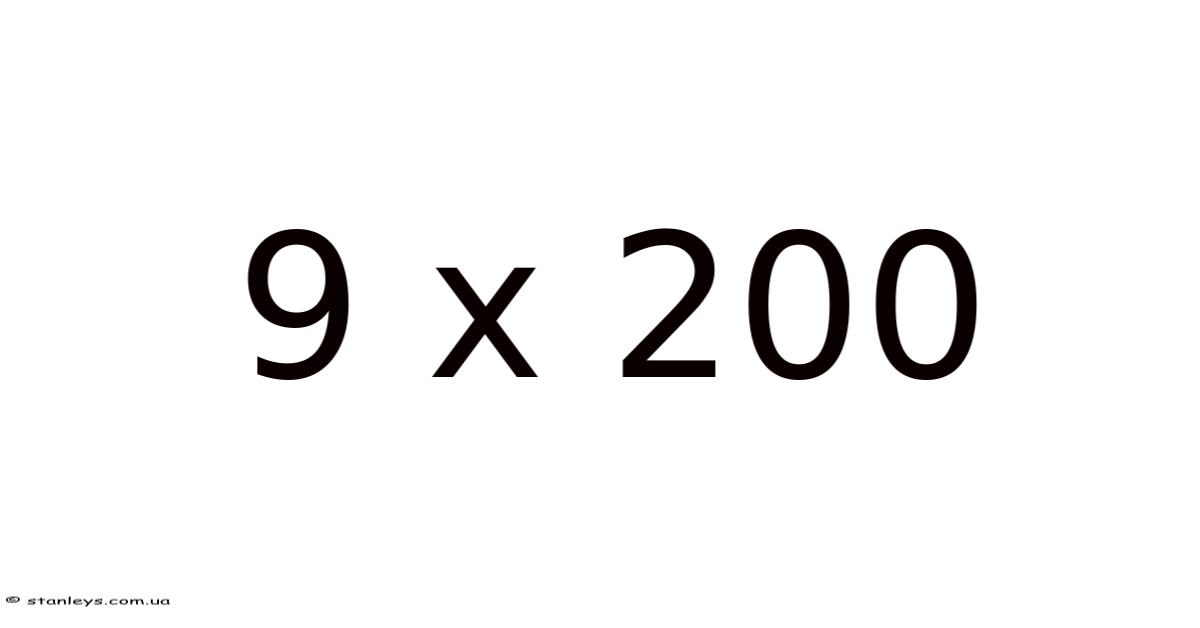
Unveiling the Wonders of 9 x 200: A Deep Dive into Multiplication and its Applications
This article explores the seemingly simple multiplication problem of 9 x 200, delving far beyond the immediate answer. Because of that, we'll uncover the underlying mathematical principles, explore various methods for solving this problem, and demonstrate its relevance in practical scenarios. We’ll also touch upon the broader context of multiplication and its crucial role in numerous fields. Understanding 9 x 200 isn't just about getting the answer; it's about grasping the fundamental building blocks of mathematics and appreciating its practical applications in everyday life Simple, but easy to overlook. Turns out it matters..
Understanding the Basics: Multiplication and its Properties
Before diving into 9 x 200, let's refresh our understanding of multiplication. Also, multiplication is essentially repeated addition. As an example, 9 x 200 means adding 200 nine times: 200 + 200 + 200 + 200 + 200 + 200 + 200 + 200 + 200. Still, multiplication provides a far more efficient way to perform this calculation.
People argue about this. Here's where I land on it.
Multiplication possesses several key properties that are crucial to understanding its application:
-
Commutative Property: The order of the numbers doesn't affect the result. 9 x 200 is the same as 200 x 9. This property is extremely useful for simplifying calculations Practical, not theoretical..
-
Associative Property: When multiplying three or more numbers, the grouping of the numbers doesn't affect the result. Here's one way to look at it: (9 x 2) x 100 is the same as 9 x (2 x 100).
-
Distributive Property: This property allows us to break down complex multiplication problems into simpler ones. Take this: 9 x (200 + 10) = (9 x 200) + (9 x 10). This is incredibly helpful when dealing with larger numbers.
-
Identity Property: Multiplying any number by 1 results in the same number. This might seem trivial, but it's a fundamental property of multiplication.
-
Zero Property: Multiplying any number by 0 results in 0. This is another cornerstone property of multiplication.
Methods for Solving 9 x 200
There are several ways to solve 9 x 200, each offering a unique approach and highlighting different aspects of mathematical principles.
1. Direct Multiplication: The most straightforward approach is to perform the multiplication directly: 9 x 200 = 1800. This is easily done mentally or using a calculator That's the whole idea..
2. Using the Commutative Property: Applying the commutative property, we can switch the order: 200 x 9 = 1800. This method demonstrates the flexibility of multiplication Most people skip this — try not to..
3. Breaking Down the Problem (Distributive Property): We can break down 200 into simpler numbers, making the calculation easier:
-
9 x (100 + 100) = (9 x 100) + (9 x 100) = 900 + 900 = 1800
-
9 x (2 x 100) = (9 x 2) x 100 = 18 x 100 = 1800
This illustrates the power of the distributive property in simplifying complex problems.
4. Using Multiplication Tables: Remembering that 9 x 2 = 18, we can easily extend this to 9 x 200 by adding two zeros: 1800. This method relies on the memorization of basic multiplication facts.
Practical Applications of 9 x 200 and Multiplication in General
The seemingly simple calculation of 9 x 200 finds application in a surprising number of scenarios:
-
Unit Conversions: Imagine you have 9 bags of apples, each containing 200 apples. To find the total number of apples, you'd use 9 x 200 = 1800 apples.
-
Financial Calculations: If you're saving $200 per month for 9 months, you'll have 9 x 200 = $1800 saved.
-
Construction and Engineering: Calculating the total area of a rectangular space measuring 9 meters by 200 meters requires this multiplication.
-
Data Analysis: In data analysis, multiplication is used frequently, for example, scaling data or calculating percentages. Imagine you need to scale a dataset that contains 200 values by a factor of 9.
-
Everyday Life: From calculating the cost of multiple items to determining the total distance traveled, multiplication is an integral part of our daily lives.
Beyond 9 x 200: Exploring Larger and More Complex Multiplications
Understanding 9 x 200 lays a strong foundation for tackling more complex multiplication problems. By applying the principles and methods discussed, we can confidently approach more challenging calculations. For example:
-
Larger Numbers: Consider 9 x 2000. We can use the same strategies, recognizing that multiplying by 1000 simply adds three zeros to the result of 9 x 2 Turns out it matters..
-
Decimals: Multiplication involving decimals can be handled by treating them as fractions and applying the same principles.
-
Algebra: Multiplication plays a fundamental role in algebra, where variables are involved in calculations.
The Importance of Mastering Multiplication
Proficiency in multiplication isn't just about getting correct answers; it’s a cornerstone of mathematical understanding. It fosters:
-
Number Sense: A strong grasp of multiplication develops a deep understanding of numbers and their relationships.
-
Problem-Solving Skills: Multiplication is a tool used to solve a wide range of problems across various disciplines.
-
Computational Fluency: Being able to perform multiplication efficiently frees up cognitive resources for more complex problem-solving tasks.
-
Confidence in Mathematics: Mastering multiplication builds confidence and reduces math anxiety, leading to a more positive learning experience Took long enough..
Frequently Asked Questions (FAQ)
Q: What is the easiest way to calculate 9 x 200?
A: The easiest way is to recognize that 9 x 2 = 18, and then add two zeros to account for the two zeros in 200, resulting in 1800 Which is the point..
Q: Can I use a calculator to solve 9 x 200?
A: Absolutely! Calculators are a valuable tool for efficient calculation, particularly for larger numbers.
Q: Why is understanding the properties of multiplication important?
A: Understanding the properties allows for flexibility and efficiency in solving problems. It enables you to choose the most suitable approach for each calculation.
Q: How does multiplication relate to other mathematical concepts?
A: Multiplication is closely related to division, fractions, decimals, percentages, and algebra. A solid understanding of multiplication forms the basis for mastering these concepts.
Q: What are some real-world examples of where multiplication is used?
A: Multiplication is used in countless real-world situations, including finance, engineering, cooking, shopping, and many more. Anytime you need to calculate the total of multiple equal quantities, multiplication is the solution.
Conclusion: The Significance of 9 x 200 and Beyond
The seemingly simple problem of 9 x 200 offers a profound glimpse into the world of mathematics. Mastering multiplication, starting with simple examples like 9 x 200, builds a solid foundation for more complex mathematical concepts and enhances problem-solving skills applicable in numerous areas of life. By exploring different solution methods and examining its practical applications, we have uncovered not only the answer (1800) but also the underlying principles that govern this fundamental operation. It’s a journey of understanding, not just calculation. The true value lies in appreciating the elegance and power of mathematics itself The details matter here..
