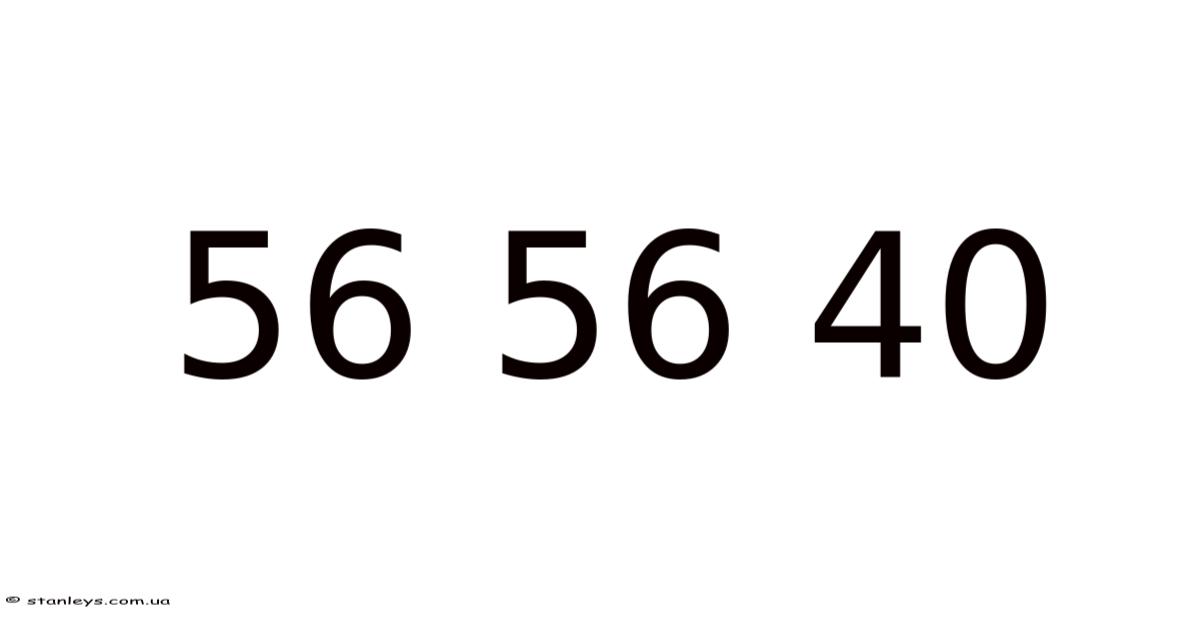
Decoding the Enigma: Understanding the Significance of "56 56 40"
The number sequence "56 56 40" lacks a universally recognized meaning. This absence suggests that its significance, if any, is highly context-dependent. This article will explore various potential interpretations, examining the mathematical, statistical, and even circumstantial possibilities behind this seemingly random string of numbers. Unlike established codes or symbolic sequences, it doesn't appear in widely known dictionaries, encyclopedias, or established systems of numerology. Understanding its meaning requires a systematic investigation, leaving no stone unturned in the search for a plausible explanation Not complicated — just consistent..
Mathematical Exploration: Patterns and Relationships
Let's begin by examining the numbers themselves. The number 56 appears twice, followed by 40. "56 56 40" immediately suggests a potential pattern: repetition. This repetition might indicate a specific data structure or a deliberate choice within a larger system.
-
Prime Factorization: Breaking down each number into its prime factors reveals no immediately obvious connections. 56 = 2 x 2 x 2 x 7, and 40 = 2 x 2 x 2 x 5. While they share a common factor of 8 (2 x 2 x 2), this alone is not sufficient to establish a significant mathematical relationship Worth keeping that in mind..
-
Arithmetic Progression: The sequence doesn't follow a simple arithmetic progression (constant difference between consecutive numbers). There's a difference of 0 between the first two numbers and a difference of -16 between the second and third. This lack of consistent arithmetic relationship makes an arithmetic explanation unlikely.
-
Geometric Progression: Similarly, it does not exhibit a clear geometric progression (constant ratio between consecutive numbers). The ratio between 56 and 56 is 1, while the ratio between 56 and 40 is approximately 1.4. Again, this inconsistency rules out a straightforward geometric interpretation.
-
Fibonacci-like Sequences: We could explore if it relates to variations of Fibonacci sequences or other number sequences with recursive patterns. On the flip side, initial analysis shows no direct correspondence with known sequences.
Statistical Considerations: Probability and Randomness
From a statistical perspective, the probability of randomly selecting the sequence "56 56 40" depends heavily on the context. Day to day, ), the probability shifts significantly. Still, if we assume a uniform distribution across a range of numbers (e. In real terms, , 0-99), the probability is incredibly low. Even so, if the numbers represent something else (measurements, codes, coordinates, etc.g.Without knowing the underlying distribution or generating process, determining the statistical significance is impossible.
This is the bit that actually matters in practice Simple, but easy to overlook..
A crucial aspect to consider is whether the numbers represent discrete events or continuous measurements. If they are measurements (e.g.But , time, distance, weight), then slight variations could be expected due to measurement error. This would render an exact match less critical and open up possibilities for near-matches Small thing, real impact..
Contextual Clues: The Search for Meaning
The absence of inherent mathematical or statistical patterns suggests that the meaning of "56 56 40" lies within its context. To decipher its significance, we need additional information. Several possibilities exist:
-
Codes and Ciphers: The sequence could be part of a code or cipher. Without a key or algorithm, decryption is impossible. It could be a simple substitution cipher, a more complex transposition cipher, or even a type of code using a specific lexicon. This requires further information about the potential code's design and purpose.
-
Measurements and Coordinates: The numbers might represent measurements, such as dimensions (e.g., length, width, height) or coordinates (e.g., geographical location, Cartesian coordinates). The units of measurement are crucial. Here's a good example: 56 meters, 56 centimeters, and 40 millimeters would be very different from 56 degrees latitude, 56 degrees longitude, and 40 meters altitude Not complicated — just consistent. Which is the point..
-
Dates and Times: While unlikely without additional context, the sequence could represent a date or time using a specific system. As an example, it could be a date code in a manufacturing process or a timestamp in a database. Understanding the date or time system is necessary to interpret the sequence accurately Simple, but easy to overlook..
-
Serial Numbers or Product Codes: The sequence might be a part of a serial number or product code. Many industries use numbering systems to track products. These codes are often more than just simple identifiers. They might contain information about the product's manufacturing location, date, or other attributes.
-
Specific Systems or Applications: The numbers could be unique to a particular system or application. If you encountered this number sequence within a specific software, game, or technical document, consulting the documentation related to that system is crucial.
A Deeper Dive into Potential Contexts
Let's explore some more specific hypothetical scenarios:
Scenario 1: Engineering or Manufacturing: Imagine "56 56 40" represents dimensions in millimeters for a manufactured component. This is quite possible in many engineering designs. Without knowing the units (millimeters, centimeters, inches, etc.) we remain unable to derive a conclusion.
Scenario 2: Geographic Coordinates: If interpreted as coordinates, the meaning could range from a specific location on Earth to a point in a simulated environment (e.g., a game). This requires knowing the coordinate system being used (latitude/longitude, UTM, etc.) Not complicated — just consistent..
Scenario 3: A Cryptographic Key Fragment: In a more complex context, "56 56 40" could be a small part of a larger cryptographic key. The significance would become evident only once the full key is obtained and the encryption algorithm is identified.
Frequently Asked Questions (FAQ)
Q: Is "56 56 40" a significant number in any known numerological system?
A: No, there's no established numerological system that assigns specific meaning to the sequence "56 56 40." Numerology systems are usually based on the reduction of numbers to single digits or specific relationships between numbers with symbolic meanings.
Q: Could this be a lottery number?
A: Statistically, the probability of winning a lottery with the numbers "56 56 40" is the same as winning with any other random combination of numbers. While it might hold personal significance for someone, it has no inherent mathematical advantage.
Q: Is there a website or database that can decode this sequence?
A: There is no single resource that can reliably decode an arbitrary number sequence like "56 56 40" without additional context. The meaning, if any, is specific to the context in which it appears Most people skip this — try not to..
Q: What steps should I take if I encounter this sequence again?
A: Carefully document the circumstances surrounding the appearance of "56 56 40." Note the source (e.g., a document, a website, a conversation) and any additional information provided nearby. This contextual information is crucial for deciphering its meaning.
Conclusion: Context is King
The enigma of "56 56 40" underscores the importance of context in interpreting numerical data. On the flip side, the key to unlocking its meaning lies in diligently investigating its context and pursuing any associated information, however seemingly insignificant it might appear initially. This seemingly random sequence might represent a simple measurement, a complex code, or something entirely different. Remember, the most plausible explanation is the one supported by the strongest evidence within its specific context. Without further information about its origin and surrounding circumstances, any interpretation is pure speculation. Until that context is provided, "56 56 40" remains an intriguing mystery.
