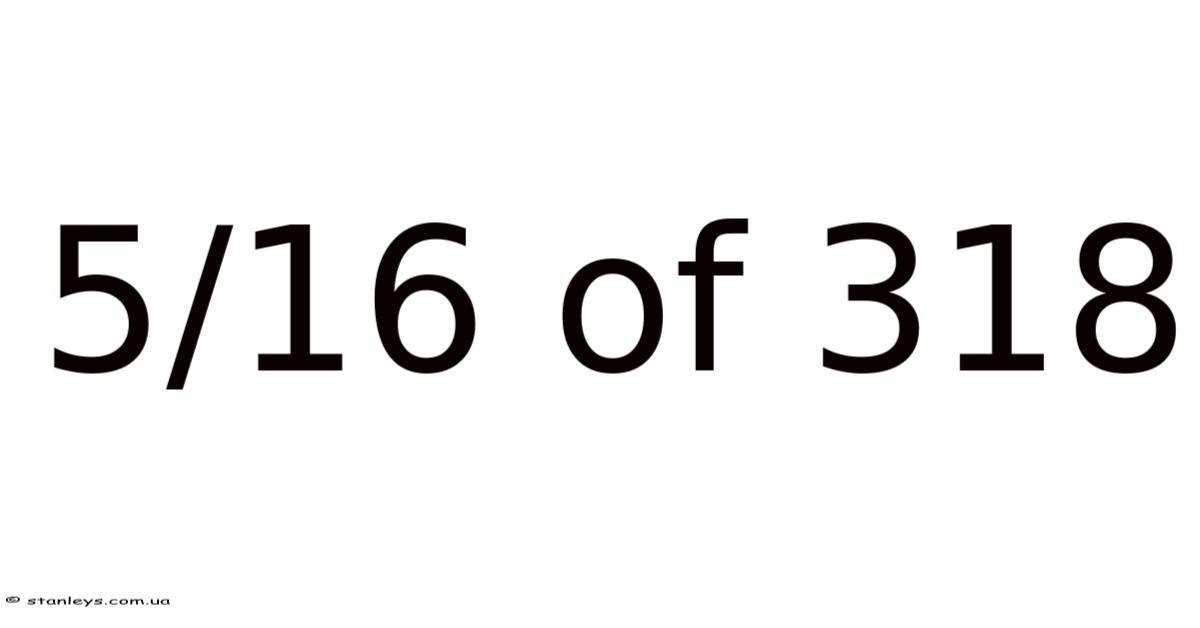
Decoding 5/16 of 318: A practical guide to Fraction Multiplication
This article provides a step-by-step guide on how to calculate 5/16 of 318, explaining the underlying principles of fraction multiplication and offering practical applications. On top of that, understanding this seemingly simple calculation unlocks a deeper comprehension of fractions, percentages, and their real-world relevance in various fields like finance, engineering, and everyday life. We'll explore the process, address common misconceptions, and get into the mathematical reasoning behind it. This practical guide aims to equip you with the knowledge and confidence to tackle similar problems independently.
Understanding Fractions: A Quick Refresher
Before we dive into calculating 5/16 of 318, let's briefly review the fundamental concepts of fractions. A fraction represents a part of a whole. It's composed of two main parts:
- Numerator: The top number, indicating how many parts we have. In our example, 5/16, the numerator is 5.
- Denominator: The bottom number, indicating the total number of equal parts the whole is divided into. In 5/16, the denominator is 16.
Because of this, 5/16 represents 5 out of 16 equal parts of a whole.
Method 1: Converting to Decimal First
One approach to solving 5/16 of 318 is to convert the fraction 5/16 into its decimal equivalent. This method is particularly useful if you're more comfortable working with decimals Still holds up..
Step 1: Convert the Fraction to a Decimal
To convert 5/16 to a decimal, we divide the numerator (5) by the denominator (16):
5 ÷ 16 = 0.3125
Step 2: Multiply the Decimal by the Whole Number
Now, multiply the decimal equivalent (0.3125) by the whole number (318):
0.3125 x 318 = 99.375
Because of this, 5/16 of 318 is 99.375 It's one of those things that adds up. Nothing fancy..
Method 2: Direct Fraction Multiplication
This method involves directly multiplying the fraction by the whole number. This approach offers a deeper understanding of the underlying mathematical principles Easy to understand, harder to ignore. That alone is useful..
Step 1: Express the Whole Number as a Fraction
First, express the whole number 318 as a fraction by placing it over 1:
318/1
Step 2: Multiply the Numerators and Denominators
Now, multiply the two fractions:
(5/16) x (318/1) = (5 x 318) / (16 x 1) = 1590 / 16
Step 3: Simplify the Resulting Fraction
The resulting fraction, 1590/16, can be simplified by finding the greatest common divisor (GCD) of the numerator and denominator. The GCD of 1590 and 16 is 2. Divide both the numerator and denominator by 2:
1590 ÷ 2 = 795 16 ÷ 2 = 8
This simplifies the fraction to 795/8 Turns out it matters..
Step 4: Convert to a Decimal (Optional)
To obtain the decimal equivalent, divide the numerator (795) by the denominator (8):
795 ÷ 8 = 99.375
Which means, 5/16 of 318 is 99.375, confirming the result obtained using the decimal method It's one of those things that adds up..
Mathematical Explanation: Why This Works
The process of finding a fraction of a whole number relies on the fundamental concept of multiplication. When we say "5/16 of 318," we're essentially asking for 5/16 * 318. Which means this is equivalent to dividing 318 into 16 equal parts and then taking 5 of those parts. The multiplication of fractions ensures that we accurately capture this proportional relationship Worth keeping that in mind..
Real-World Applications: Where This Calculation Matters
Understanding fraction multiplication isn't just an academic exercise; it has widespread practical applications:
- Finance: Calculating interest, discounts, or proportions of investments.
- Engineering: Determining material quantities, scaling designs, or calculating proportions in construction.
- Cooking and Baking: Adjusting recipes, scaling ingredients up or down.
- Data Analysis: Representing proportions within data sets.
- Everyday Life: Dividing shared costs, calculating portions, or understanding percentages in sales.
Common Mistakes to Avoid
Several common errors can occur when calculating fractions:
- Incorrect Order of Operations: Always follow the order of operations (PEMDAS/BODMAS).
- Errors in Simplification: Ensure you find the greatest common divisor when simplifying fractions.
- Decimal Rounding Errors: Be mindful of rounding errors when converting between fractions and decimals. Try to maintain accuracy throughout the calculation.
Frequently Asked Questions (FAQ)
Q1: Can I solve this using a calculator?
A1: Yes, most calculators can handle fraction multiplication directly or through decimal conversions. On the flip side, understanding the manual process is crucial for grasping the underlying mathematical principles Simple, but easy to overlook..
Q2: What if the fraction is an improper fraction (numerator > denominator)?
A2: The process remains the same. You would still multiply the numerators and denominators and then simplify the resulting fraction.
Q3: Is there another way to simplify 1590/16?
A3: Yes. Here's one way to look at it: you can notice both numbers are even and divide both by 2, resulting in 795/8. Consider this: you can simplify in stages. Since 795 is not divisible by 8, we know we've reached the simplest form.
Q4: Why is it important to understand fraction multiplication?
A4: Understanding fraction multiplication is fundamental for tackling a wide range of mathematical problems and solving real-world situations that involve proportions, ratios, and percentages Still holds up..
Conclusion: Mastering Fraction Multiplication
Calculating 5/16 of 318, while seemingly simple, demonstrates the power and applicability of fraction multiplication. In real terms, work through similar problems and explore different approaches to build your confidence and expertise. This skill is invaluable in numerous fields, enhancing your problem-solving abilities and enriching your understanding of mathematical concepts. Remember, practice is key to mastering this fundamental skill. By understanding the underlying principles and avoiding common pitfalls, you can confidently tackle similar problems in various contexts. The ability to work fluently with fractions is a cornerstone of numeracy and opens doors to further mathematical exploration.
