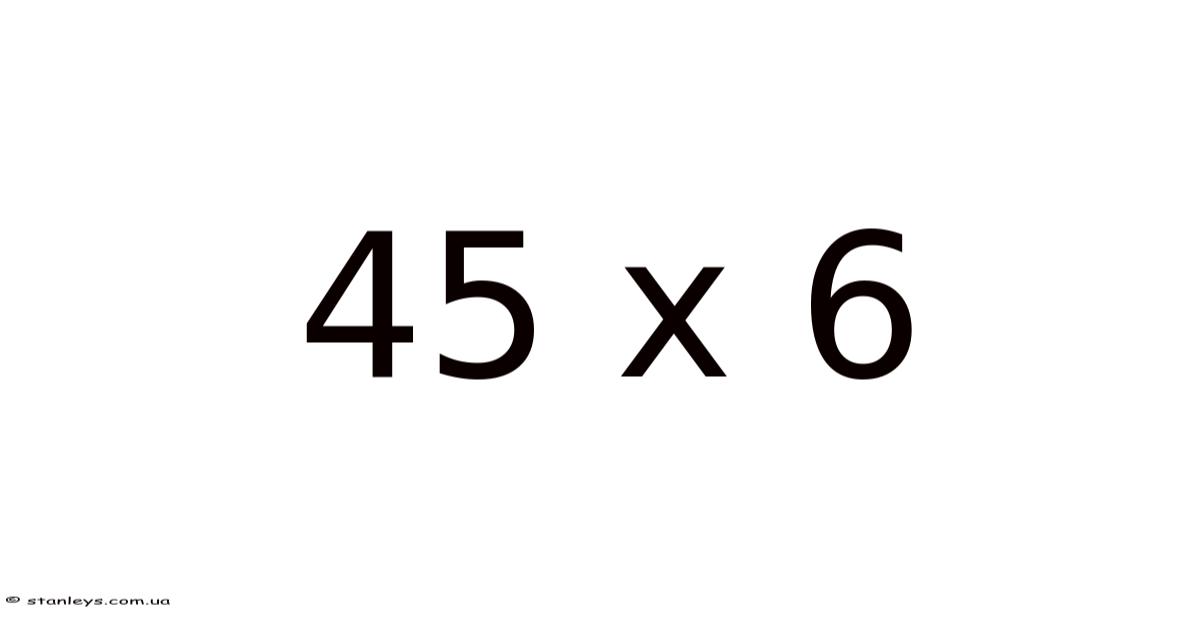
Decoding 45 x 6: A Deep Dive into Multiplication and its Applications
This article explores the seemingly simple multiplication problem 45 x 6, going far beyond the immediate answer. We'll unpack the various methods for solving it, look at the underlying mathematical concepts, and explore its relevance in real-world scenarios. And understanding this seemingly basic calculation opens doors to a deeper appreciation of mathematics and its practical applications in everyday life. This full breakdown is perfect for students, educators, and anyone curious about the power of multiplication No workaround needed..
This is the bit that actually matters in practice.
I. Introduction: More Than Just an Answer
At first glance, 45 x 6 appears to be a straightforward multiplication problem. Because of that, the answer, 270, is readily obtained using various methods. Still, this seemingly simple equation provides a springboard to explore fundamental mathematical principles, different calculation techniques, and the practical applications of multiplication in various fields. We'll examine the problem from multiple perspectives, highlighting the richness and versatility of even the most basic arithmetic operations. This exploration will reveal the beauty and utility of mathematics, moving beyond rote memorization to genuine understanding Easy to understand, harder to ignore..
II. Solving 45 x 6: Multiple Approaches
There are several ways to solve 45 x 6, catering to different learning styles and levels of mathematical understanding. Let's explore some of the most common methods:
-
Standard Multiplication Algorithm: This is the method most commonly taught in schools. It involves multiplying each digit of 45 by 6, starting with the ones place, and then adding the results.
  45
 x 6
 ---
 270
Here, 6 x 5 = 30, we write down 0 and carry-over 3. Then 6 x 4 = 24, adding the carry-over 3 gives 27. Thus, the answer is 270 That alone is useful..
-
Distributive Property: This method breaks down the problem into smaller, easier-to-manage parts. We can rewrite 45 as 40 + 5. Then, applying the distributive property, we get:
6 x (40 + 5) = (6 x 40) + (6 x 5) = 240 + 30 = 270
-
Repeated Addition: This method, while less efficient for larger numbers, reinforces the concept of multiplication as repeated addition. We simply add 45 six times:
45 + 45 + 45 + 45 + 45 + 45 = 270
-
Using a Multiplication Table: For those familiar with multiplication tables, the answer can be quickly obtained by looking up the intersection of 45 and 6 (although most standard multiplication tables don't go up to 45) That's the part that actually makes a difference..
-
Mental Math Techniques: With practice, mental math strategies can be employed. Here's one way to look at it: one could double 45 to get 90, then double 90 to get 180, and finally add another 90 to obtain 270 (This is utilizing the doubling method) Still holds up..
III. The Underlying Mathematics: Factors, Multiples, and Prime Factorization
The simple equation 45 x 6 reveals a wealth of mathematical concepts. Let's dig into some of them:
-
Factors: The factors of a number are the numbers that divide it evenly. The factors of 45 are 1, 3, 5, 9, 15, and 45. The factors of 6 are 1, 2, 3, and 6. Notice that 3 is a common factor of both 45 and 6.
-
Multiples: Multiples are the products of a number and any integer. 270 is a multiple of both 45 and 6.
-
Prime Factorization: Expressing a number as a product of its prime factors (numbers divisible only by 1 and themselves) is a fundamental concept in number theory. The prime factorization of 45 is 3² x 5, and the prime factorization of 6 is 2 x 3. The prime factorization of 270 is 2 x 3³ x 5. This reveals the relationship between the factors of the original numbers and the factors of their product Small thing, real impact..
-
Commutative Property of Multiplication: This property states that the order of the numbers being multiplied doesn't affect the result. Because of this, 45 x 6 is equal to 6 x 45. This seemingly simple property has profound implications in more advanced mathematical operations Worth keeping that in mind..
IV. Real-World Applications: Where does 45 x 6 show up?
While seemingly abstract, multiplication finds countless practical uses in our daily lives. Here are a few examples where a calculation similar to 45 x 6 might be relevant:
-
Shopping: Imagine buying 6 items that cost $45 each. The total cost would be 45 x 6 = $270 And it works..
-
Manufacturing: A factory producing 45 units of a product per hour might want to calculate its output over a 6-hour period.
-
Construction: Calculating the total number of bricks needed if each row requires 45 bricks and there are 6 rows.
-
Cooking: If a recipe calls for 45 grams of an ingredient per serving and you're making 6 servings Simple, but easy to overlook..
-
Travel: Calculating the total distance traveled if you drive 45 km/hour for 6 hours.
These examples demonstrate the practical utility of multiplication in everyday tasks, highlighting its importance beyond the classroom. The ability to quickly and accurately perform such calculations contributes to efficiency and problem-solving skills in numerous real-world contexts.
V. Extending the Concept: Beyond 45 x 6
Understanding 45 x 6 allows us to extrapolate to more complex scenarios. This simple problem serves as a building block for understanding:
-
Larger Multiplications: The same principles and methods can be applied to larger numbers, providing a foundation for tackling more challenging problems.
-
Algebra: The concepts of variables and equations build upon fundamental arithmetic operations, including multiplication. Understanding the relationship between numbers helps in solving algebraic expressions.
-
Geometry: Calculating areas and volumes frequently involve multiplication. Understanding area calculations of rectangles (length x width) is directly related to this core concept.
-
Data Analysis: Multiplication is crucial in calculating percentages, ratios, and proportions, which are essential for analyzing data and making informed decisions.
VI. Frequently Asked Questions (FAQ)
-
Q: What is the easiest way to solve 45 x 6? A: The easiest way depends on individual preference and mathematical comfort. The standard algorithm is commonly taught, but the distributive property or mental math techniques can be equally effective And it works..
-
Q: Why is it important to learn multiplication? A: Multiplication is a fundamental building block of mathematics, essential for problem-solving in various fields, from everyday finances to advanced scientific calculations.
-
Q: How can I improve my multiplication skills? A: Practice is key! Regularly working through multiplication problems, using different methods, and applying them to real-world scenarios helps build proficiency and understanding.
-
Q: Are there any online resources to help me practice multiplication? A: While I cannot provide external links, a simple online search for "multiplication practice" will yield many helpful websites and apps designed for all skill levels.
VII. Conclusion: The Enduring Value of Understanding
The seemingly simple problem of 45 x 6 provides a gateway to understanding fundamental mathematical principles and their broad applications. By exploring various solution methods, delving into the underlying concepts, and highlighting its relevance in diverse contexts, we've demonstrated the enduring value of mastering this basic operation. So this exploration goes beyond rote memorization, encouraging a deeper appreciation of mathematics and its power to tap into solutions to real-world challenges. From grocery shopping to complex scientific endeavors, the ability to understand and apply multiplication is a valuable skill that transcends the limitations of a single equation. The journey from 45 x 6 to a broader understanding of mathematics is a rewarding one, empowering individuals with the tools to analyze, solve problems, and manage the complexities of the world around them.
