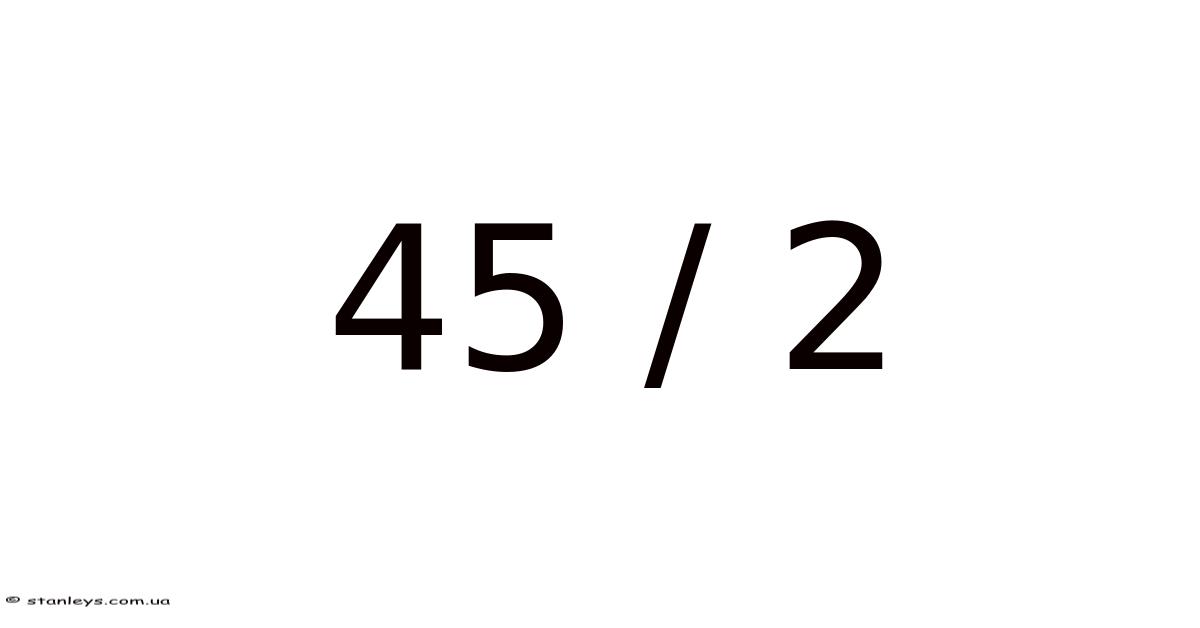
Decoding 45 / 2: A Deep Dive into Division and its Applications
This article explores the seemingly simple division problem, 45 / 2, delving beyond the immediate answer to uncover the underlying mathematical principles, practical applications, and related concepts. Understanding this seemingly basic calculation unlocks a broader comprehension of arithmetic, fractions, decimals, and their relevance in everyday life and advanced mathematical fields. We'll break down the process step-by-step, examining different approaches and exploring the significance of remainders Worth knowing..
Not the most exciting part, but easily the most useful Most people skip this — try not to..
Introduction: More Than Just a Simple Calculation
At first glance, 45 / 2 appears to be a straightforward division problem. Even so, a closer examination reveals opportunities to explore various mathematical concepts and their practical implementations. And 5) and digs into the nuances of division, including whole numbers, fractions, decimals, and the importance of understanding remainders. This exploration goes beyond simply finding the answer (which is 22.We'll cover various methods for solving this problem, highlighting the versatility and interconnectedness of mathematical operations.
People argue about this. Here's where I land on it.
Methods for Solving 45 / 2
Several methods can be employed to solve 45 / 2, each providing unique insights into the nature of division.
1. Long Division: This classic method is foundational for understanding the mechanics of division.
- Step 1: Divide the tens digit (4) by 2. 4 divided by 2 equals 2. Write the 2 above the 4 in the quotient.
- Step 2: Multiply the quotient digit (2) by the divisor (2). 2 x 2 = 4. Write this below the 4 in the dividend.
- Step 3: Subtract the result (4) from the tens digit (4). 4 - 4 = 0.
- Step 4: Bring down the ones digit (5) from the dividend.
- Step 5: Divide the new number (5) by the divisor (2). 5 divided by 2 equals 2 with a remainder of 1. Write the 2 in the quotient.
- Step 6: Multiply the quotient digit (2) by the divisor (2). 2 x 2 = 4. Write this below the 5.
- Step 7: Subtract the result (4) from 5. 5 - 4 = 1. This is the remainder.
That's why, using long division, 45 / 2 = 22 with a remainder of 1.
2. Converting to a Fraction: Division can also be expressed as a fraction. 45 / 2 can be written as 45/2 Most people skip this — try not to..
- This fraction is an improper fraction because the numerator (45) is larger than the denominator (2).
- To convert this to a mixed number, we perform the division: 45 ÷ 2 = 22 with a remainder of 1. This translates to the mixed number 22 1/2.
3. Decimal Representation: To obtain a decimal representation, we continue the long division process beyond the remainder.
- After obtaining the remainder of 1 in the long division process, we add a decimal point to the dividend (45) and append a zero. This becomes 10.
- We then divide 10 by 2, which equals 5.
- This gives us the final answer of 22.5.
Understanding the Remainder
The remainder (1 in this case) represents the portion of the dividend that is left over after the division is complete. Its significance depends on the context of the problem.
- In the context of whole numbers: If you're dividing 45 objects into 2 equal groups, you would have 22 in each group and 1 object left over.
- In the context of decimals: The remainder is incorporated into the decimal portion of the answer, resulting in 22.5.
The remainder's interpretation highlights the difference between whole number division and division resulting in decimals or fractions Easy to understand, harder to ignore..
Practical Applications
The division 45 / 2, and the concepts it embodies, appears in countless everyday scenarios and advanced mathematical applications:
- Sharing Resources: Dividing 45 candies among 2 friends.
- Calculating Averages: Finding the average score of two tests where one is 40 and the other is 50 (total 90/2 = 45; then perhaps finding the average of multiple such scores).
- Measurement Conversions: Converting inches to centimeters (or vice-versa), especially if dealing with fractional units.
- Engineering and Physics: Numerous calculations in engineering and physics involve dividing quantities, often leading to decimal or fractional results. Understanding remainders can be crucial for accurate measurements and calculations.
- Computer Science: Binary arithmetic and other forms of numerical representation in computer science fundamentally rely on division and remainder operations.
- Financial Calculations: Dividing profits amongst shareholders, calculating average transaction values.
- Cooking and Baking: Scaling recipes up or down involves proportional reasoning and often requires dividing quantities of ingredients.
- Geometry and Trigonometry: Many geometric calculations, especially those involving areas and volumes, often involve fractional or decimal results.
Beyond the Basics: Exploring Related Concepts
Understanding 45 / 2 opens doors to exploring more advanced mathematical ideas:
- Fractions and Decimals: This problem demonstrates the relationship between fractions (45/2) and decimals (22.5). It highlights how fractions can be converted to decimals and vice-versa, illustrating the flexibility of representing numerical values.
- Modular Arithmetic: The remainder (1) is central to modular arithmetic, which is used in cryptography, computer science, and other fields. Modular arithmetic deals with remainders after division.
- Ratio and Proportion: The division problem can be framed as a ratio (45:2), expressing a relationship between two quantities. This ratio can be simplified or scaled to represent equivalent ratios.
- Algebra: This simple problem lays the groundwork for solving algebraic equations involving division. Understanding division is essential for working with variables and unknown quantities.
Frequently Asked Questions (FAQ)
Q1: What is the exact answer to 45 / 2?
A1: The exact answer is 22.Now, 5 or 22 1/2. The choice between decimal and fractional representation depends on the context of the problem.
Q2: What if I get a different answer using a calculator?
A2: Most calculators will directly provide the decimal answer, 22.5. Discrepancies could arise from incorrect input or calculator malfunction. Double-check your input and try using a different calculator to verify the result.
Q3: Why is it important to understand remainders?
A3: Remainders are crucial for understanding the context of division, particularly in situations where only whole numbers are meaningful (e.Consider this: , dividing objects among people). g.They also have significant applications in higher-level mathematics and computer science.
Q4: How can I practice solving similar division problems?
A4: Practice using different methods (long division, fractions, decimals) to solve various division problems. In real terms, start with simple ones and gradually increase complexity. Online resources and textbooks provide ample practice exercises Worth keeping that in mind..
Conclusion: A Deeper Appreciation of Division
The seemingly simple calculation 45 / 2 offers a rich opportunity to explore foundational mathematical concepts, their interconnections, and their widespread applications. Even so, from understanding the mechanics of long division to grasping the significance of remainders and exploring the relationships between fractions and decimals, this problem provides a gateway to a deeper appreciation of arithmetic and its relevance in various aspects of life and advanced mathematical fields. Which means by mastering this basic concept, we lay a strong foundation for tackling more complex mathematical problems and real-world challenges. Which means remember that the process of solving the problem is just as important, if not more so, than the answer itself. It's the understanding of why and how that truly unlocks mathematical potential Turns out it matters..
