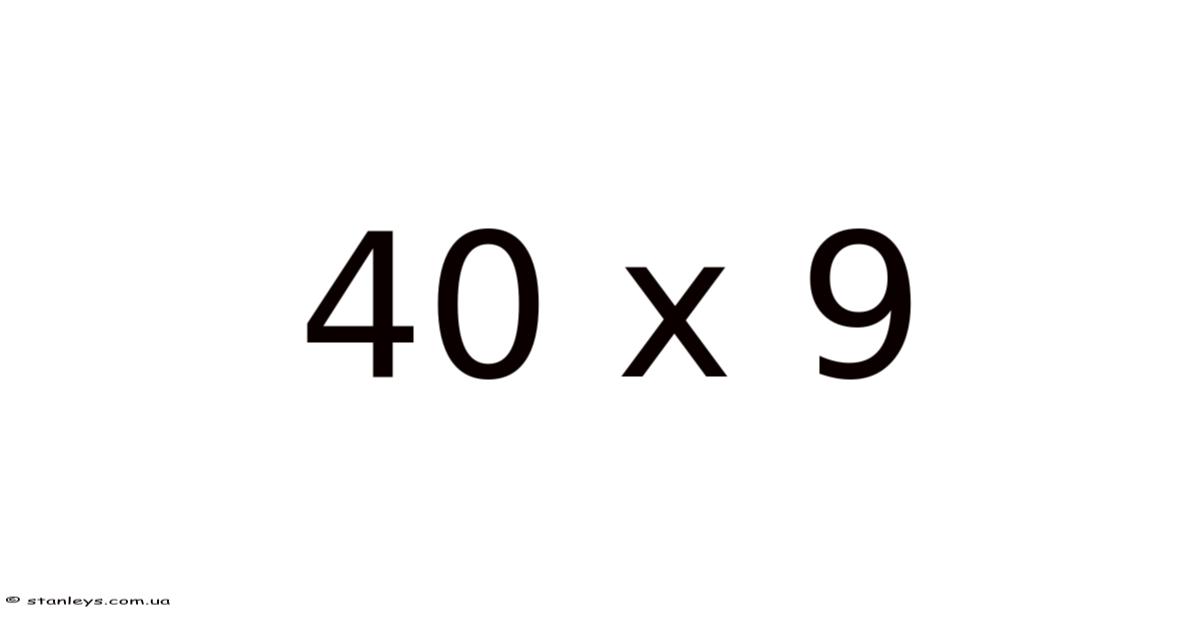
Decoding 40 x 9: A Deep Dive into Multiplication and its Applications
This article explores the seemingly simple multiplication problem, 40 x 9, as a gateway to understanding fundamental mathematical concepts and their real-world applications. We'll move beyond simply finding the answer to dig into the underlying principles, different methods of calculation, and the broader significance of multiplication in various fields. This full breakdown is suitable for students, educators, and anyone curious about the power and versatility of mathematics.
Understanding the Basics: Multiplication Defined
Multiplication, at its core, is repeated addition. Think of it like arranging items in a grid: 40 rows and 9 columns, or vice versa. This fundamental understanding lays the groundwork for grasping more complex mathematical operations. When we say 40 x 9, we are essentially asking: what is the sum of forty nines? The total number of items represents the product of the multiplication And it works..
Calculating 40 x 9: Various Approaches
Several methods can be employed to solve 40 x 9. Let's explore some, catering to different skill levels and preferences:
1. Standard Multiplication Algorithm:
This is the most commonly taught method in schools. It involves multiplying the ones digit first, followed by the tens digit, and then adding the results Not complicated — just consistent..
- Step 1: Multiply the ones digit of 40 (0) by 9: 0 x 9 = 0.
- Step 2: Multiply the tens digit of 40 (4) by 9: 4 x 9 = 36.
- Step 3: Combine the results: 360.
Which means, 40 x 9 = 360.
2. Distributive Property:
The distributive property of multiplication over addition states that a(b + c) = ab + ac. We can use this to break down the problem:
- Rewrite 40 as 4 x 10.
- Apply the distributive property: (4 x 10) x 9 = 4 x (10 x 9).
- Solve: 4 x 90 = 360.
This method highlights the flexibility of mathematical principles and allows for breaking down complex problems into simpler ones.
3. Mental Math Techniques:
For quicker calculations, mental math techniques are invaluable. One such technique involves using the fact that multiplying by 10 is easy:
- Multiply 40 by 10: 40 x 10 = 400.
- Since 9 is one less than 10, subtract 40 from 400: 400 - 40 = 360.
4. Using a Multiplication Table:
A multiplication table provides a quick reference for common multiplication facts. Locating the intersection of the row for 40 (or 9) and the column for 9 (or 40) will directly yield the answer 360. While a standard multiplication table may not explicitly list 40, understanding the underlying pattern and place value allows for easy derivation Most people skip this — try not to. Practical, not theoretical..
Beyond the Calculation: Exploring the Significance of 40 x 9
While finding the answer (360) is important, let's explore the broader context and applications of such calculations:
1. Real-World Applications:
- Inventory Management: Imagine a store with 40 boxes of items, each containing 9 units. 40 x 9 helps determine the total number of items (360).
- Construction and Engineering: Calculating the number of bricks needed for a wall, the area of a floor, or the volume of a container frequently involves multiplication.
- Finance: Calculating interest, discounts, or profits often relies on multiplication.
- Everyday Life: From calculating the total cost of multiple items to determining distances or quantities, multiplication is ubiquitous.
2. Connecting to Other Mathematical Concepts:
- Factors and Multiples: Understanding factors and multiples helps in breaking down numbers and finding relationships between them. The numbers 40 and 9 are factors of 360, while 360 is a multiple of both 40 and 9.
- Prime Factorization: Breaking down 360 into its prime factors (2³ x 3² x 5) helps understand its fundamental building blocks.
- Algebra: Multiplication is a fundamental operation in algebra, used in equations, expressions, and solving problems involving unknown variables. As an example, solving for 'x' in the equation 9x = 360.
3. Enhancing Problem-Solving Skills:
Solving multiplication problems, regardless of their complexity, develops crucial problem-solving skills. It teaches:
- Systematic Approach: Following a step-by-step process to arrive at a solution.
- Attention to Detail: Accuracy is critical in multiplication; even a small mistake can significantly impact the final answer.
- Critical Thinking: Evaluating different methods and selecting the most efficient approach.
Frequently Asked Questions (FAQ)
-
Q: What are some common mistakes when calculating 40 x 9?
- A: A common mistake is misplacing the zero in the ones place when multiplying 4 by 9, leading to an incorrect answer. Carefully following the standard algorithm or using mental math techniques can mitigate this error.
-
Q: Are there other ways to represent 40 x 9?
- A: Yes, it can be represented as 9 x 40 (commutative property), or as a repeated addition problem: 9 + 9 + 9 + ... (40 times). It can also be visualized as a rectangular area with dimensions 40 units by 9 units.
-
Q: How does understanding 40 x 9 help in learning more advanced mathematics?
- A: Mastering basic multiplication like 40 x 9 builds a solid foundation for more complex concepts like algebra, calculus, and beyond. It strengthens number sense and computational skills, crucial for higher-level mathematical studies.
-
Q: What are some resources for practicing multiplication?
- A: Workbooks, online educational games, and interactive apps offer various ways to practice multiplication skills. Consistent practice is key to mastering this fundamental operation.
Conclusion: The Enduring Power of Multiplication
The seemingly simple calculation of 40 x 9 serves as a powerful illustration of the broader significance of multiplication in mathematics and everyday life. From understanding fundamental principles to applying them in various contexts, this exploration unveils the depth and versatility of this core mathematical operation. Now, by grasping the different methods of calculation and the underlying mathematical concepts, we reach a deeper appreciation for the power and elegance of mathematics. Even so, the journey from simply finding the answer (360) to understanding the 'why' behind it transforms a basic calculation into a stepping stone towards greater mathematical proficiency and problem-solving capabilities. Continuous practice and exploration of related concepts will further solidify this understanding and empower you to tackle even more complex mathematical challenges with confidence Worth keeping that in mind..
