Decoding the Ratio: A Deep Dive into 40/6 and its Applications
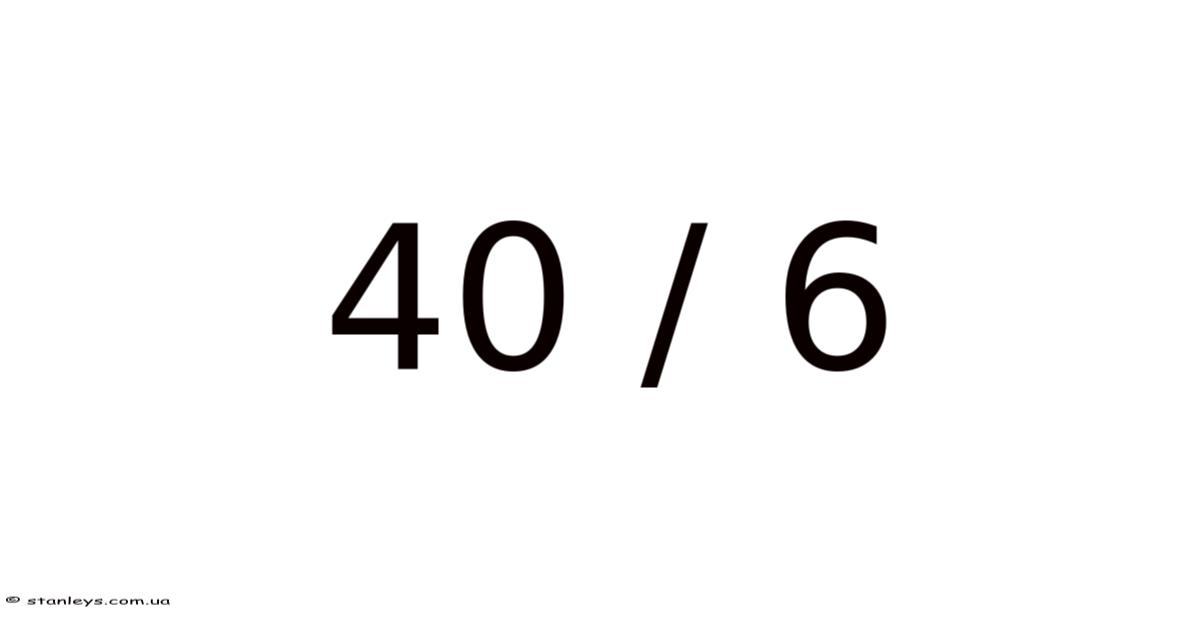
The seemingly simple ratio of 40/6, or its simplified form of 20/3, holds far more significance than initially meets the eye. This article gets into the multifaceted world of 40/6, exploring its mathematical properties, practical applications, and the underlying principles that govern its interpretation. Day to day, this ratio, representing a relationship between two quantities, finds application across diverse fields, from mathematics and engineering to cooking and even music. We'll examine how this ratio manifests in real-world scenarios and the importance of understanding its implications That's the whole idea..
Understanding the Basics: Ratio and Proportion
Before we break down the specifics of 40/6, let's establish a foundational understanding of ratios and proportions. That's why a ratio is a comparison of two or more quantities. Which means it shows the relative size of one quantity compared to another. Ratios can be expressed in several ways: using the colon (e.Think about it: g. A proportion, on the other hand, is a statement that two ratios are equal. , 40:6), as a fraction (40/6), or using the word "to" (40 to 6). To give you an idea, 40/6 = 20/3 is a proportion because both ratios represent the same relationship Practical, not theoretical..
The ratio 40/6 can be simplified by dividing both the numerator and the denominator by their greatest common divisor, which is 2. Worth adding: this simplification yields the equivalent ratio 20/3. This simplified form is often easier to work with and provides a clearer understanding of the underlying relationship.
Mathematical Properties of 40/6 (20/3)
The ratio 20/3 is an improper fraction, meaning the numerator (20) is larger than the denominator (3). This improper fraction can be converted into a mixed number by performing the division: 20 ÷ 3 = 6 with a remainder of 2. So, 20/3 can be expressed as 6⅔. This mixed number representation provides a practical way to understand the relationship between the two quantities – there are 6 whole units and two-thirds of another unit.
Not the most exciting part, but easily the most useful.
Beyond its representation as a fraction or mixed number, 20/3 can also be expressed as a decimal: approximately 6.666... Because of that, this repeating decimal highlights the fact that the ratio represents a non-terminating, recurring decimal value. This characteristic is important when performing calculations involving this ratio, especially in contexts requiring precise measurements or calculations.
Applications of the 40/6 Ratio in Real-World Scenarios
The 40/6 ratio, or its simplified form 20/3, finds surprisingly broad applications across various fields. Let's explore some examples:
1. Engineering and Construction: In engineering and construction projects, the 40/6 ratio might represent the proportion of different materials used in a mixture or the relationship between dimensions in a design. As an example, a concrete mix might require 20 parts cement to 3 parts water, reflecting the 20/3 ratio. Similarly, the dimensions of certain structural components could adhere to this ratio for optimal strength and stability. Careful calculation and adherence to these proportions are crucial for structural integrity and safety.
2. Cooking and Baking: Recipes often involve ratios to ensure consistent results. A recipe might call for 20 parts flour to 3 parts sugar, resulting in a 20/3 ratio. Accurate adherence to these ratios is crucial in baking, as even slight variations can significantly affect the final product's texture and taste. The precise measurement and proportional mixing are essential for consistent baking results.
3. Music and Harmony: Musical harmony and rhythm often involve ratios. While not directly expressed as 40/6, underlying mathematical relationships mirroring this ratio could influence musical composition and structure. The frequencies of notes within a chord might bear a proportional relationship, subtly influencing the overall harmonic effect.
4. Finance and Economics: In financial modeling and economic analysis, ratios are indispensable tools. While 40/6 itself might not be a frequently used ratio in standard financial metrics, similar ratios are used extensively in areas like debt-to-equity ratios or profitability ratios. Understanding ratios is crucial for interpreting financial statements and making informed investment decisions.
5. Science and Research: In scientific experiments and research, the 40/6 ratio could potentially appear in different contexts, depending on the nature of the study. To give you an idea, in chemical reactions, the ratio of reactants might be expressed in this way, affecting the outcome of the experiment.
Explaining the Ratio's Significance Through Examples
To illustrate the practical applications of the 40/6 (20/3) ratio, let's consider a few detailed examples:
Example 1: Concrete Mixture
A construction project requires a concrete mix with a cement-to-water ratio of 20:3. If the project needs 60 units of cement, how much water is needed?
We can set up a proportion: 20/3 = 60/x
Solving for x: 20x = 180, therefore x = 9. The project needs 9 units of water.
Example 2: Baking a Cake
A cake recipe calls for 20 parts flour to 3 parts sugar. If a baker wants to use 100 grams of flour, how much sugar is needed?
Again, we set up a proportion: 20/3 = 100/x
Solving for x: 20x = 300, therefore x = 15. The baker needs 15 grams of sugar.
These examples clearly show how understanding and applying the ratio helps maintain the proportions and results in consistent outcomes, whether in construction or baking.
Frequently Asked Questions (FAQ)
Q1: What is the simplest form of the ratio 40/6?
A1: The simplest form of 40/6 is 20/3, obtained by dividing both the numerator and denominator by their greatest common divisor, which is 2.
Q2: Can the ratio 40/6 be expressed as a decimal?
A2: Yes, 40/6 (or 20/3) is approximately equal to 6.666... It's a recurring decimal.
Q3: What are some real-world applications of ratios similar to 40/6?
A3: Ratios are used extensively in various fields, including engineering (material proportions), cooking (recipe ingredients), finance (financial ratios), and science (chemical reactions). The specific ratio might vary but the concept remains essential Most people skip this — try not to..
Q4: Why is understanding ratios important?
A4: Understanding ratios is crucial for scaling recipes, designing structures, performing calculations, and interpreting data across many disciplines. It allows for consistent results and accurate predictions.
Q5: How do I convert an improper fraction like 20/3 into a mixed number?
A5: To convert an improper fraction to a mixed number, divide the numerator (20) by the denominator (3). The quotient becomes the whole number part, and the remainder (2) becomes the numerator of the fraction part, with the denominator remaining the same (3). Thus, 20/3 becomes 6⅔.
People argue about this. Here's where I land on it It's one of those things that adds up..
Conclusion: The Enduring Relevance of Ratios
The seemingly simple ratio of 40/6, or its simplified equivalent 20/3, demonstrates the pervasive nature of ratios in our world. Consider this: from the precise measurements in engineering to the subtle harmonies in music, the application of ratios is widespread and critical for achieving consistency, precision, and optimal outcomes. Understanding the mathematical properties and practical applications of ratios, such as 40/6, is not merely an academic exercise; it's a foundational skill applicable to various aspects of life. The ability to interpret, manipulate, and apply ratios equips individuals with the tools to tackle challenges and solve problems across a spectrum of fields, strengthening problem-solving capabilities and fostering a deeper appreciation for the mathematical foundations of our world. By understanding the intricacies of this seemingly simple ratio, we open up a greater understanding of the mathematical relationships that underpin our daily lives The details matter here. Worth knowing..
