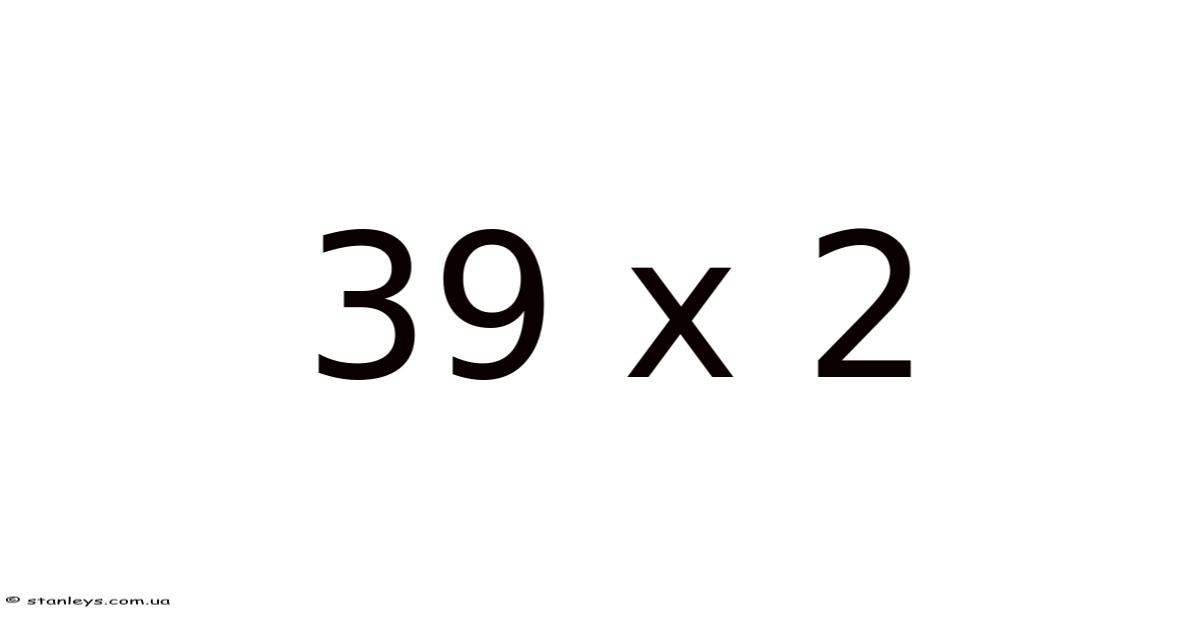
Unveiling the Wonders of 39 x 2: A Deep Dive into Multiplication
This article looks at the seemingly simple calculation of 39 x 2, exploring its various applications, underlying mathematical principles, and surprising connections to broader mathematical concepts. Here's the thing — we'll move beyond a simple answer, examining the problem through different lenses to reveal its hidden richness and educational value. This exploration is ideal for anyone looking to strengthen their fundamental arithmetic skills, understand the beauty of mathematics, or appreciate the power of seemingly simple calculations Simple, but easy to overlook..
Understanding the Fundamentals: Multiplication Basics
Before we tackle 39 x 2, let's refresh our understanding of multiplication. Multiplication is essentially repeated addition. Practically speaking, when we say 39 x 2, we're essentially asking: "What is the sum of two 39s? " This can be visually represented as two groups of 39 objects each.
This fundamental understanding is crucial because it provides a concrete, tangible representation of the abstract concept of multiplication. It helps to build a strong intuitive grasp of what multiplication means, which is vital for more advanced mathematical concepts Still holds up..
Calculating 39 x 2: Multiple Methods
There are several ways to calculate 39 x 2, each offering a different perspective and strengthening various mathematical skills.
Method 1: Direct Multiplication
The most straightforward approach is direct multiplication using the standard algorithm:
   39
x   2
----
   78
This method involves multiplying the units digit (9) by 2 (resulting in 18), carrying-over the 1 to the tens column, and then multiplying the tens digit (3) by 2 and adding the carried-over 1 (resulting in 7). In practice, this yields the final answer of 78. This method is efficient and widely taught, emphasizing place value and the distributive property Simple, but easy to overlook..
Method 2: Distributive Property
The distributive property of multiplication over addition states that a(b + c) = ab + ac. We can apply this to our problem:
39 x 2 = (30 + 9) x 2 = (30 x 2) + (9 x 2) = 60 + 18 = 78
This method breaks down the problem into smaller, more manageable parts, making it easier to understand and calculate, especially for larger numbers. It reinforces the understanding of how multiplication interacts with addition.
Method 3: Doubling
This method utilizes the concept of doubling. Since multiplying by 2 is equivalent to doubling, we can simply double 39:
39 + 39 = 78
This method is particularly helpful for mental arithmetic and emphasizes the relationship between addition and multiplication. It's a quick and intuitive way to solve the problem, especially for smaller numbers.
Beyond the Calculation: Exploring the Context
While the answer, 78, is straightforward, the calculation of 39 x 2 opens doors to exploring various mathematical concepts and real-world applications.
Real-World Applications
Imagine you're buying two items that cost $39 each. Worth adding: the total cost is directly calculated using 39 x 2, illustrating the practical application of this seemingly simple calculation in everyday life. This extends to numerous scenarios involving quantities, costs, measurements, and more Took long enough..
Number Properties and Patterns
The numbers involved (39, 2, and 78) possess interesting properties:
- 39: This is an odd number, a composite number (divisible by numbers other than 1 and itself), and can be factored as 3 x 13.
- 2: This is an even number, a prime number (only divisible by 1 and itself), and the smallest prime number.
- 78: This is an even number, a composite number, and can be factored as 2 x 3 x 13.
Exploring these properties helps in understanding number theory and developing a deeper appreciation for the relationships between numbers.
Extending to Larger Numbers
The methods used to solve 39 x 2 can be extended to solve more complex multiplication problems. The distributive property and the doubling method are particularly useful when dealing with larger numbers, breaking down complex calculations into simpler steps.
Connection to Geometry
The calculation can be visualized geometrically. Imagine a rectangle with a length of 39 units and a width of 2 units. The area of this rectangle would be 39 x 2 = 78 square units. This visual representation connects arithmetic to geometry, demonstrating the interconnectedness of mathematical concepts.
Advanced Mathematical Connections
While seemingly basic, 39 x 2 subtly touches upon advanced mathematical ideas:
- Modular Arithmetic: The remainder when 78 is divided by various numbers can be explored. To give you an idea, 78 divided by 3 leaves a remainder of 0, highlighting concepts of divisibility and modular arithmetic.
- Number Bases: The calculation can be performed in different number bases (e.g., binary, hexadecimal) offering a glimpse into different number systems.
- Abstract Algebra: Multiplication is a fundamental operation in abstract algebra, and understanding its properties in a simple context like 39 x 2 builds a foundation for more abstract concepts.
Frequently Asked Questions (FAQ)
Q: What is the easiest way to calculate 39 x 2?
A: The easiest method depends on your preference and mathematical strengths. Direct multiplication is efficient, the distributive property is conceptually clear, and doubling is intuitive for mental calculations.
Q: Can I use a calculator to solve 39 x 2?
A: Absolutely! Calculators are useful tools, particularly for more complex calculations. Even so, understanding the underlying methods is crucial for developing strong mathematical skills No workaround needed..
Q: Why is it important to understand different methods of multiplication?
A: Understanding multiple methods enhances your mathematical flexibility and problem-solving skills. Different methods are advantageous in different contexts, and a strong grasp of various techniques promotes deeper understanding.
Q: How can I improve my multiplication skills?
A: Practice is key! Regularly solve multiplication problems, explore different methods, and try to visualize the calculations. Use resources like flashcards, online games, and workbooks to enhance your learning.
Conclusion: The Unexpected Depth of a Simple Calculation
The seemingly simple calculation of 39 x 2 serves as a gateway to explore a wealth of mathematical concepts. But from fundamental arithmetic operations to advanced mathematical principles, this seemingly trivial problem offers a surprising depth of learning and understanding. By exploring different calculation methods, examining the properties of the numbers involved, and connecting the calculation to real-world applications and higher-level mathematical concepts, we reveal the richness and beauty hidden within even the simplest arithmetic problems. That said, this approach not only reinforces basic mathematical skills but also fosters a deeper appreciation for the power and elegance of mathematics as a whole. Remember, the journey of mathematical understanding is a continuous exploration, and every calculation, no matter how simple, holds the potential for profound learning.
