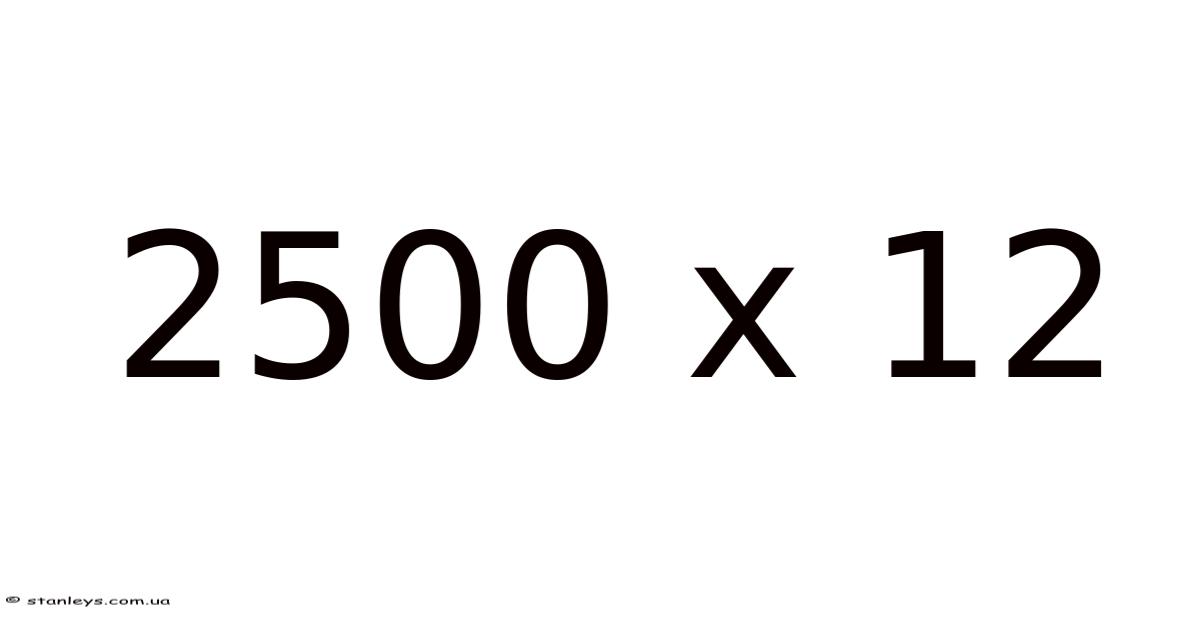
Decoding 2500 x 12: Exploring the Dimensions and Applications
This article digs into the meaning and implications of the dimensions "2500 x 12," exploring its relevance across various fields. This seemingly simple expression can represent a multitude of things, from the dimensions of a physical object to a resolution in digital imaging, or even a mathematical expression. Which means understanding the context is key to deciphering its true meaning. We will unravel the possible interpretations and applications of this numerical pair, providing a comprehensive overview for diverse audiences That's the whole idea..
Understanding the Context: Dimensions and Units
The expression "2500 x 12" inherently represents a ratio or a set of dimensions. On the flip side, without specifying the units, its meaning remains ambiguous. The units could be anything from millimeters (mm) and centimeters (cm) to inches (in), feet (ft), or even pixels. This ambiguity underscores the critical need for clarity when dealing with measurements.
Let's consider some potential interpretations based on common applications:
1. Physical Dimensions: Length and Width
In the context of physical objects, 2500 x 12 could represent the length and width of a surface, a piece of material, or a rectangular object. The units would define the scale:
- 2500 mm x 12 mm: This could describe a small rectangular component, perhaps in electronics or precision engineering.
- 2500 cm x 12 cm: This suggests a larger object, potentially a piece of fabric, a sheet of metal, or a panel.
- 2500 in x 12 in: This would represent a very large object, possibly a billboard, a section of a wall, or a large piece of industrial machinery.
- 2500 ft x 12 ft: This scale points towards extremely large structures, perhaps a building foundation or a significant portion of a large construction project. The context here is crucial in determining the actual application.
2. Digital Imaging: Resolution and Aspect Ratio
In the realm of digital imaging, "2500 x 12" could represent the resolution of an image or video. Consider this: the numbers denote the number of pixels in the horizontal (2500) and vertical (12) directions. But an image with this resolution would be extremely narrow and long, a highly unusual aspect ratio. This resolution might be used in specialized applications like panoramic photography requiring extreme horizontal length or in very niche scientific imaging processes Small thing, real impact. That alone is useful..
3. Mathematical Interpretations: Multiplication and Ratio
Mathematically, "2500 x 12" simply represents multiplication. The result, 30000, could have various interpretations depending on the context. This could represent:
- Total quantity: If 2500 represents items per unit and 12 is the number of units, the result (30000) would be the total number of items.
- Area calculation: If 2500 and 12 represent the length and width of a rectangle, then the result (30000) would be the area of that rectangle, with the units squared (e.g., square millimeters, square inches, etc.).
- Scaling factor: In scaling operations, this expression could represent a scaling factor applied to an object or image.
Practical Applications across Disciplines
The interpretation of "2500 x 12" varies considerably across different fields. Let's explore some specific examples:
1. Manufacturing and Engineering
In manufacturing, this could represent the dimensions of a metal sheet, a printed circuit board, a section of a building component, or the size of a die-cut part. Precision and accuracy are key in these contexts; thus, the units used are crucial.
2. Construction and Architecture
In architecture and construction, such dimensions might be used in blueprints to represent the dimensions of walls, floors, or other structural elements. Scale drawings are often used, meaning the numbers might represent a scaled-down version of the real-world dimensions.
3. Textile and Fashion
In the textile industry, "2500 x 12" could refer to the dimensions of a roll of fabric, a piece of textile material, or a pattern design. The units would likely be centimeters or inches, depending on standard industry practices That alone is useful..
4. Graphic Design and Printing
In graphic design, this expression could be related to image resolution, print dimensions, or the size of a banner design. The units would usually be pixels or inches, and attention is paid to high-resolution for print output Most people skip this — try not to..
5. Data Analysis and Statistics
The numbers could represent data points in a statistical analysis. To give you an idea, 2500 could represent the number of observations and 12 the number of variables, although this is a less likely scenario given the large discrepancy between the two numbers.
Importance of Specifying Units and Context
As demonstrated, the meaning of "2500 x 12" is highly dependent on the context and the associated units. Without clearly specifying these, any interpretation would be purely speculative. Now, clear communication and detailed descriptions are essential to avoid ambiguity and misinterpretations, especially in professional settings where accuracy and precision are crucial. Always confirm that the units (millimeters, centimeters, inches, pixels, etc.) are explicitly stated alongside the numerical values.
Expanding the Understanding: Related Concepts
To further grasp the implications of "2500 x 12," let's explore some related concepts:
- Aspect Ratio: In digital imaging and video production, the aspect ratio refers to the proportional relationship between the width and height of an image or video frame. The ratio for 2500 x 12 would be 2500:12, a highly elongated aspect ratio.
- Scale: In engineering drawings, maps, and architectural blueprints, scale is used to represent real-world dimensions in a smaller format. Understanding the scale is essential to accurately interpret the measurements.
- Resolution: In digital imaging, the resolution refers to the number of pixels used to create an image. Higher resolution generally means more detail and clarity. A 2500 x 12 resolution is exceptionally narrow.
- Area: The area of a rectangle is calculated by multiplying its length and width. For 2500 x 12, the area would be 30,000 square units (e.g., square millimeters, square centimeters, square inches).
- Volume: If "2500 x 12" represents the dimensions of a three-dimensional object, the volume would be calculated by multiplying the length, width, and height.
Frequently Asked Questions (FAQ)
Q: What is the most likely meaning of "2500 x 12"?
A: There's no single most likely meaning. The context is very important. Without knowing the units and application, it could represent many things, from dimensions of a physical object to image resolution or a mathematical expression.
Q: What are some possible units for "2500 x 12"?
A: The units could include millimeters, centimeters, inches, feet, pixels, or other relevant units based on the application And that's really what it comes down to..
Q: How do I determine the correct interpretation of "2500 x 12"?
A: Look for accompanying information such as units, context (e.Still, g. , type of project, field of application), and any other relevant details And that's really what it comes down to..
Q: Is 2500 x 12 a standard size for anything?
A: It's not a standard size in most common applications. The highly unusual aspect ratio (in the case of imaging) makes it unlikely to be a standard dimension No workaround needed..
Conclusion: Context is King
Pulling it all together, the interpretation of "2500 x 12" is entirely context-dependent. Plus, always prioritize clarifying the units and the context in which this expression is used. Understanding the units and the surrounding information is critical to accurate interpretation, especially in professional fields where precise measurements and clear communication are essential. This seemingly simple numerical expression can represent various things depending on its application. Remember, the devil is in the detail, and precise communication is key to avoiding misunderstandings and errors.
You'll probably want to bookmark this section Easy to understand, harder to ignore..
