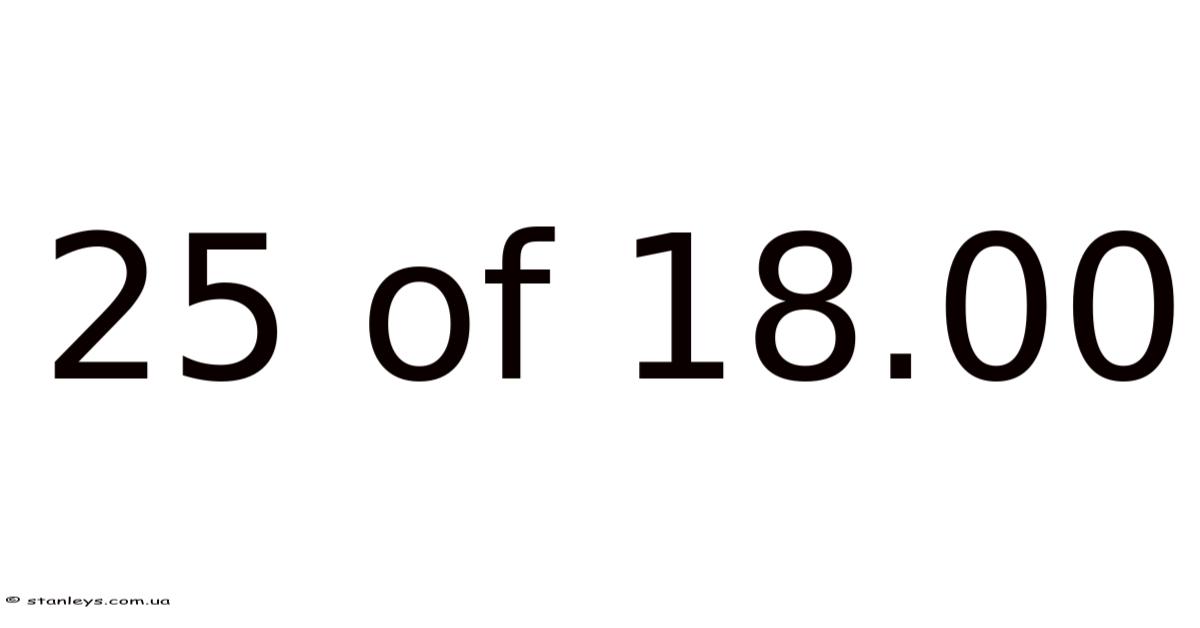
Decoding "25 of 18.00": Understanding Time, Fractions, and Context
The seemingly simple phrase "25 of 18.Which means 00" can be quite perplexing. Consider this: at first glance, it appears mathematically impossible – how can you have 25 of something that only comprises 18? The key to understanding this lies in recognizing the context. Think about it: this article will explore the various interpretations of "25 of 18. So naturally, 00," focusing on the possible meanings in different scenarios, particularly those related to timekeeping, fractional representation, and potential errors. We'll break down the mathematical implications and offer practical examples to clarify the meaning And it works..
Understanding the Potential Meanings
The ambiguity of "25 of 18.The number "18.00" could represent various things: hours in a workday, minutes in a specific period, or even units within a larger system. 00" stems from the lack of explicit units. The "25" then represents a portion or a fraction of this total.
1. Timekeeping in a 24-Hour Clock System:
This is possibly the most common interpretation, particularly within scheduling or time-tracking systems. Now, "18. Also, 00" typically signifies 6:00 PM in a 24-hour clock format. The "25" in this context could represent a task duration exceeding the standard working hours. Also, for instance, if a project started at 6:00 PM and took 25 hours, it would finish at 7:00 PM two days later. The "18.00" acts as a reference point, not a strict limit Small thing, real impact. Simple as that..
Most guides skip this. Don't.
Example: A construction project begins at 6:00 PM (18.00) and requires 25 hours of continuous work That's the part that actually makes a difference. That alone is useful..
2. Timekeeping with Overlapping Shifts or Tasks:
In situations with overlapping work schedules or multiple task assignments, "25 of 18.00" could denote that a total of 25 hours of work is distributed across a scheduled 18-hour period. This is common in project management where different teams might work on the same project at various times, and summing up the total time spent may result in a value greater than the scheduled hours The details matter here..
Counterintuitive, but true.
Example: Three teams work on a project. Team A works for 10 hours, Team B for 8 hours, and Team C for 7 hours, all within an 18-hour window. The total work time is 25 hours ("25 of 18.00").
3. Fractional Representation and Error:
The phrase could represent a mathematical error or an unusual fractional notation. It might be an attempt to express 25/18 or 25 out of 18. While mathematically impossible in a direct sense (you can't have 25 out of 18 whole objects), this interpretation might indicate an error in data entry or a misinterpretation of the context. It could also represent a scenario where the 18 unit is divisible into smaller sub-units, such as minutes or seconds, allowing the 25 to represent a greater total duration.
Example (Error): Perhaps there was a data entry mistake, and the intended value was 18.00 hours, but the input was incorrectly recorded as "25 of 18.00."
Example (Fractional): Imagine a system where 18.00 represents 18 units (e.g., 18 segments of a task), each divisible into smaller parts. 25 then represents the completion of 25 such smaller segments, exceeding the planned 18 units.
4. Contextual Units and Subdivisions:
In specific fields, the phrase might have a unique meaning tied to a particular unit. The number 18.00 might represent a capacity limit, a standard unit of measure, or a specific resource. And for instance, a factory might have a machine with a 18-hour capacity, and “25 of 18. 00” could denote an extended run of 25 hours despite the limit.
Easier said than done, but still worth knowing.
Example: "The machine ran for 25 hours ('25 of 18.00') before requiring maintenance, exceeding its standard capacity of 18 hours."
Mathematical Analysis and Implications
From a purely mathematical perspective, "25 of 18.00" is inconsistent. It violates the fundamental principle that you cannot have more parts than the whole. Still, this doesn't necessarily mean the phrase is meaningless. Also, it highlights the importance of considering the context and units involved. The statement does not adhere to standard mathematical fraction notation (25/18). It's crucial to look beyond strict mathematical rules and examine the context of the situation to determine the intended meaning.
Clarifying the Context: Essential Steps
To correctly understand "25 of 18.00," we need to establish the context. Ask these questions:
- What does 18.00 represent? Is it hours, minutes, units of work, or something else entirely?
- What does 25 represent? Is it a total duration, number of units, or another measure relative to the 18.00?
- What is the specific scenario or system? This information often holds the key to unlocking the meaning.
The context is key in interpreting ambiguous phrases like this. Without clear context, the statement remains open to multiple interpretations Nothing fancy..
Practical Examples Across Different Scenarios
Let's explore how "25 of 18.00" could appear in different real-world scenarios:
Scenario 1: Project Management Software
Imagine a project management software that displays task durations. Worth adding: the software might report this as "25 of 18. That said, due to unexpected delays or added work, the total time spent on the project is 25 hours. A project might have an allocated time of 18 hours (18.00). 00," indicating that the actual time exceeded the initial allocation.
It sounds simple, but the gap is usually here The details matter here..
Scenario 2: Manufacturing Production
A factory might have a machine with an operational capacity of 18 hours per day (18.And 00). Consider this: in a high-demand period, they ran the machine for 25 hours ("25 of 18. 00"), exceeding its standard operating time to meet production goals. This would represent an overload on the machine.
Scenario 3: Data Entry Error in a Timesheet
A worker might accidentally enter "25" instead of "18" on a timesheet, resulting in the entry "25 of 18.Because of that, 00. " This is a clear data entry error that needs correction.
Scenario 4: Cumulative Work Hours Across Multiple Shifts
A team working on a project might have a schedule with multiple 8-hour shifts. If 3 shifts (24 hours) are worked plus 1 additional hour, the total work could be described as "25 of 18.00," indicating the cumulative work hours (25) relative to the scheduled hours (18, perhaps representing a planned 2-shift work).
Frequently Asked Questions (FAQ)
Q1: Is "25 of 18.00" mathematically correct?
No, not in a standard mathematical sense. But you cannot have 25 units of something that only comprises 18 units. That said, the phrase is likely describing a scenario where the 18.00 represents a planned or allocated time/resource, and the 25 represents the actual time/resource used.
Not the most exciting part, but easily the most useful.
Q2: What are the most likely interpretations of "25 of 18.00"?
The most likely interpretations involve timekeeping, where 18.Consider this: , 18 hours), and 25 represents the total time spent, potentially exceeding the schedule. g.Because of that, 00 represents a scheduled time (e. Other interpretations could include data entry errors or a context-specific use of units Still holds up..
Q3: How can I avoid ambiguity when reporting time or resource usage?
Use clear and unambiguous language. That's why specify the units (e. Day to day, g. , "25 hours vs. 18 hours allocated," or "25 units out of a possible 18 units"). Avoid vague terms like "of" when referring to quantities or durations without specifying the context Which is the point..
Q4: What if I encounter "25 of 18.00" in data analysis?
Investigate the data source and context. Try to find the units for 18.00 and understand what 25 represents relative to those units. Consider the possibility of an error.
Conclusion
The phrase "25 of 18.00" is inherently ambiguous without knowing the specific context. Because of that, understanding the context, particularly the units of measurement, is crucial for deciphering the meaning. Also, careful consideration of units and the use of clear labels will prevent future misunderstandings and confirm that your data is correctly interpreted. While mathematically illogical in a direct sense, it likely represents a real-world scenario where the numbers refer to different quantities in a specific system. Always strive for clear and explicit communication to avoid such ambiguity in data reporting and documentation. Context is key – remember to always analyze the situation before attempting to interpret this potentially misleading phrase Which is the point..
It's where a lot of people lose the thread.
