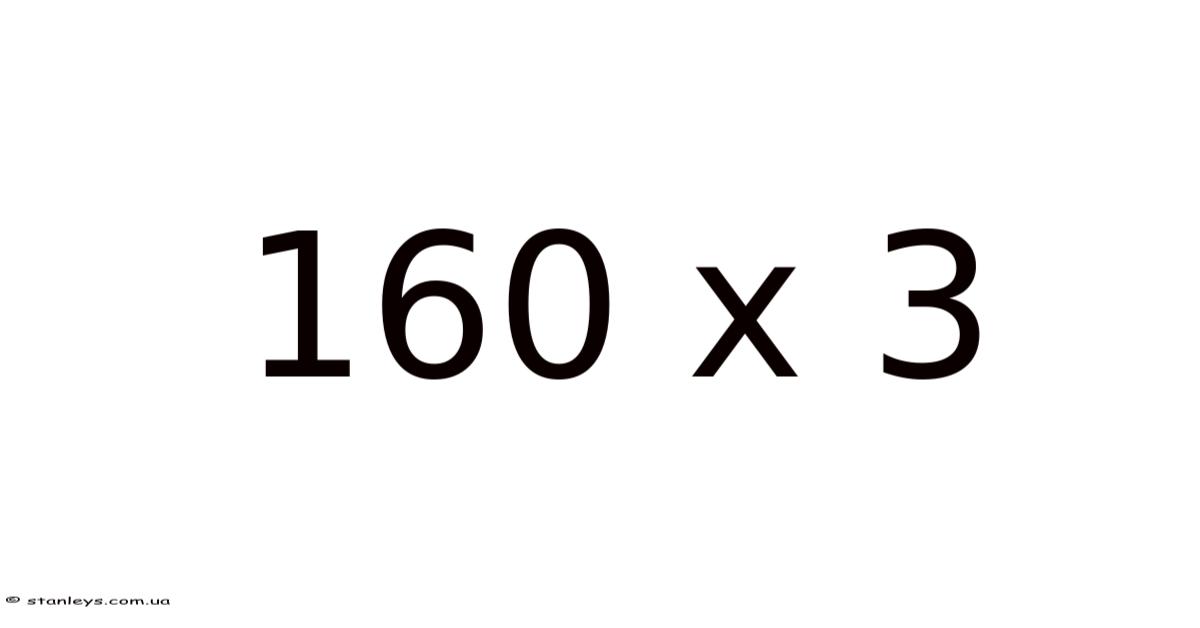
Decoding 160 x 3: Exploring Multiplication, Area, and Real-World Applications
This article gets into the seemingly simple mathematical problem of 160 x 3, exploring its solution, underlying concepts, and practical applications in various fields. That's why we'll move beyond a simple answer, examining the fundamental principles of multiplication, the geometrical representation of area, and real-world scenarios where such calculations are crucial. This exploration will be suitable for learners of all ages and backgrounds, offering a comprehensive understanding of this basic yet essential mathematical operation. Understanding 160 x 3 is not just about getting the right answer; it's about grasping the fundamental building blocks of mathematics and their relevance in everyday life.
Understanding the Fundamentals: Multiplication
Multiplication is a fundamental arithmetic operation that represents repeated addition. When we say 160 x 3, we're essentially saying "add 160 to itself three times". This can be visually represented as:
160 + 160 + 160 = 480
Still, as numbers become larger, repeated addition becomes inefficient. Multiplication provides a much quicker and more efficient method. Also, the number 160 is the multiplicand (the number being multiplied), and 3 is the multiplier (the number by which we multiply). The result, 480, is the product And that's really what it comes down to. That's the whole idea..
Calculating 160 x 3: Different Approaches
While the answer is straightforward, let's explore various methods to calculate 160 x 3, catering to different learning styles and levels of mathematical understanding Still holds up..
-
Direct Multiplication: This is the most common approach. Simply multiply 160 by 3:
160 x 3 = 480
-
Distributive Property: This involves breaking down 160 into smaller, more manageable numbers. We can rewrite 160 as 100 + 60. Then, we apply the distributive property:
(100 + 60) x 3 = (100 x 3) + (60 x 3) = 300 + 180 = 480
This method is particularly useful for mental calculations and helps build a stronger understanding of number manipulation Still holds up..
- Using a Multiplication Table: While not practical for larger numbers, referring to a multiplication table can be helpful, especially for younger learners. Knowing the multiplication facts of 3 can help in calculating 160 x 3 more efficiently.
Geometrical Interpretation: Area Calculation
The multiplication problem 160 x 3 can also be visually represented using geometry. Imagine a rectangle with a length of 160 units and a width of 3 units. The area of this rectangle is calculated by multiplying its length and width:
Easier said than done, but still worth knowing.
Area = Length x Width = 160 x 3 = 480 square units
This geometrical interpretation provides a concrete visual representation of the multiplication process. It helps to solidify the understanding that multiplication isn't just an abstract operation but has real-world applications in measuring area and space Took long enough..
Real-World Applications of 160 x 3
The seemingly simple calculation 160 x 3 has far-reaching applications in various real-world scenarios:
-
Construction and Engineering: Imagine calculating the number of bricks needed for a wall 160 bricks long and 3 bricks high. The answer, 480, provides the required number of bricks. Similar calculations are used extensively in construction projects, determining material quantities and optimizing resource allocation.
-
Agriculture and Farming: A farmer might need to calculate the amount of fertilizer required for a field. If each row requires 160 units of fertilizer, and there are 3 rows, then a total of 480 units of fertilizer will be needed. This demonstrates the use of multiplication in resource management in agriculture.
-
Business and Finance: Calculating profit margins, total sales, or inventory levels often involves multiplication. If a company sells 160 units of a product at $3 each, the total revenue generated is $480. This highlights the importance of multiplication in business calculations.
-
Everyday Life: From calculating the total cost of 3 items priced at $160 each to determining the total distance traveled over three 160-kilometer trips, the application of 160 x 3 is surprisingly widespread in everyday life.
Exploring Variations and Extensions
Understanding 160 x 3 lays the groundwork for understanding more complex mathematical concepts. Let's explore some variations and extensions:
-
Larger Multipliers: What if we wanted to calculate 160 x 15? We can break down 15 into 10 + 5 and apply the distributive property: (160 x 10) + (160 x 5) = 1600 + 800 = 2400. This extends the understanding of multiplication to larger numbers Simple as that..
-
Decimal Multipliers: Consider 160 x 3.5. This can be solved by breaking down 3.5 into 3 + 0.5, and applying the distributive property. This introduces the concept of multiplying by decimals.
-
Algebraic Extensions: We can extend the concept to algebraic expressions. To give you an idea, solving for 'x' in the equation 3x = 480 would involve dividing both sides by 3, leading back to x = 160. This links multiplication to the broader field of algebra.
-
Using Different Number Bases: While typically done in base 10 (decimal system), multiplication can be performed in other number systems such as binary (base 2) or hexadecimal (base 16). This demonstrates the universality of the mathematical principle across different numerical systems That's the part that actually makes a difference..
Frequently Asked Questions (FAQ)
-
What is the easiest way to calculate 160 x 3? The easiest way is direct multiplication: 160 x 3 = 480. That said, the distributive property offers a helpful alternative, especially for mental calculations Simple as that..
-
What are the different methods to solve 160 x 3? Direct multiplication, the distributive property, and using a multiplication table are all valid methods. The best method depends on individual preference and the context of the problem Practical, not theoretical..
-
What are some real-world scenarios where 160 x 3 is used? This calculation is used in construction, agriculture, business, and even everyday tasks such as calculating total costs or distances It's one of those things that adds up. That's the whole idea..
-
How does 160 x 3 relate to area calculations? It represents the area of a rectangle with length 160 units and width 3 units.
-
Can this be applied to more complex problems? Yes, understanding 160 x 3 is a stepping stone for tackling more complex problems involving larger numbers, decimals, and algebraic expressions.
Conclusion
The seemingly simple calculation 160 x 3 provides a gateway to understanding fundamental mathematical principles, including multiplication, area calculation, and their applications in various fields. This understanding is not just essential for academic success but also for navigating the quantitative aspects of everyday life and making informed decisions across various disciplines. Day to day, by exploring different methods of calculation, visualizing the problem geometrically, and examining its real-world applications, we've moved beyond a simple numerical answer to a deeper understanding of this core mathematical concept. The journey from a simple calculation to a deeper grasp of its implications highlights the power and elegance of mathematics Simple, but easy to overlook. Which is the point..
Easier said than done, but still worth knowing.
