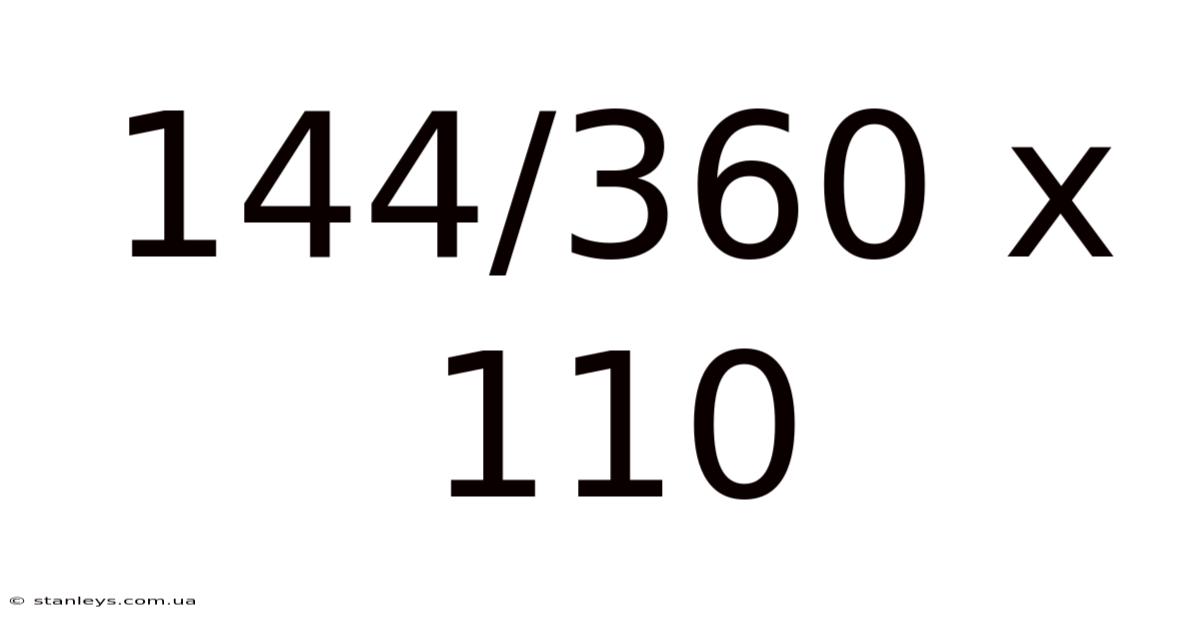
Decoding 144/360 x 110: A Deep Dive into Fraction, Ratio, and Proportion
This article explores the mathematical expression "144/360 x 110," breaking down its components and demonstrating how to solve it. But we'll break down the concepts of fractions, ratios, and proportions, explaining their practical applications and offering a step-by-step solution to this specific problem. Understanding this seemingly simple equation provides a foundation for tackling more complex mathematical challenges in various fields, from everyday calculations to advanced scientific applications.
Understanding the Components: Fractions, Ratios, and Proportions
Before we tackle the equation, let's refresh our understanding of its core elements The details matter here..
Fractions: Representing Parts of a Whole
A fraction represents a part of a whole. Now, it's expressed as a ratio of two numbers: the numerator (the top number) and the denominator (the bottom number). So the numerator indicates the number of parts considered, while the denominator represents the total number of equal parts in the whole. In our equation, 144/360 is a fraction. It signifies 144 parts out of a total of 360 equal parts.
Ratios: Comparing Quantities
A ratio compares two or more quantities. In real terms, it can be expressed using a colon (e. g., 1:2) or as a fraction (e.g., 1/2). In our equation, we can interpret 144/360 as a ratio comparing 144 to 360. Think about it: this ratio can be simplified to its lowest terms by finding the greatest common divisor (GCD) of 144 and 360. That said, the GCD of 144 and 360 is 72. Dividing both the numerator and the denominator by 72 simplifies the fraction to 2/5.
Proportions: Establishing Equivalence
A proportion states that two ratios are equal. It's often represented as two equal fractions. Practically speaking, this means we're finding a value that maintains the same ratio as 2/5 but with a different denominator (110). But when we multiply the simplified fraction (2/5) by 110, we're finding a proportional value. In real terms, our equation involves a proportion implicitly. This is commonly used in scaling, conversions, and other comparative analyses.
Solving the Equation: A Step-by-Step Guide
Now let's solve the equation 144/360 x 110:
Step 1: Simplify the Fraction
As established above, the fraction 144/360 can be simplified to 2/5 by dividing both the numerator and the denominator by their greatest common divisor, which is 72.
Step 2: Perform the Multiplication
Now we have the simplified equation: (2/5) x 110
To multiply a fraction by a whole number, multiply the numerator by the whole number and keep the denominator the same:
(2 x 110) / 5 = 220/5
Step 3: Simplify the Result
Finally, simplify the resulting fraction:
220/5 = 44
Which means, the solution to the equation 144/360 x 110 is 44 Still holds up..
Practical Applications and Real-World Examples
Understanding fractions, ratios, and proportions, as demonstrated through this equation, is crucial in various real-world scenarios:
-
Scaling Recipes: If a recipe calls for 144 grams of flour and makes 360 cookies, you can use this equation to determine how much flour is needed to make 110 cookies Easy to understand, harder to ignore..
-
Calculating Percentages: The fraction 144/360 represents 40% (144/360 x 100 = 40). The equation helps to calculate 40% of 110.
-
Geometric Proportions: In geometry, similar shapes have proportional sides. This equation might be used to calculate the length of one side of a shape given the proportions of similar shapes Which is the point..
-
Financial Calculations: Many financial calculations involve ratios and proportions, such as calculating interest, discounts, or profit margins.
-
Data Analysis: In data analysis, ratios and proportions are used to compare different data sets, identifying trends and patterns Not complicated — just consistent..
Further Exploration: Expanding the Concepts
The equation 144/360 x 110 offers a starting point for exploring more complex mathematical concepts. Consider these extensions:
-
Decimals and Percentages: Expressing the fraction as a decimal (0.4) or a percentage (40%) allows for alternative calculation methods and enhanced understanding Worth keeping that in mind..
-
Algebraic Expressions: The equation can be generalized into an algebraic expression, allowing for the solution of similar problems with different numerical values.
-
Advanced Ratio and Proportion Problems: The concepts explored here form the foundation for tackling more complex problems involving multiple ratios and proportions.
Frequently Asked Questions (FAQ)
Q: Why is it important to simplify the fraction before multiplying?
A: Simplifying the fraction makes the multiplication easier and reduces the risk of errors. Working with smaller numbers simplifies the calculation and makes the process more efficient.
Q: Can I solve this equation using a calculator?
A: Yes, you can directly input the equation into a calculator to obtain the answer. On the flip side, understanding the underlying principles of fractions, ratios, and proportions is crucial for applying these concepts in various contexts Practical, not theoretical..
Q: What if the numbers in the equation were different?
A: The same principles would apply. Plus, you would still simplify the fraction, perform the multiplication, and then simplify the result. The underlying mathematical concepts remain the same regardless of the specific numbers Nothing fancy..
Q: Are there other ways to solve this type of problem?
A: Yes, you could convert the fraction to a decimal (0.And 4) and then multiply by 110. You could also use cross-multiplication if the problem was set up as a proportion with an unknown value It's one of those things that adds up. That alone is useful..
Conclusion: Mastering the Fundamentals
The seemingly simple equation 144/360 x 110 provides a gateway to understanding fundamental mathematical concepts. By mastering the principles of fractions, ratios, and proportions, you build a solid foundation for tackling more complex mathematical challenges in various fields. Remember to always simplify where possible and understand the underlying logic behind the calculations. This comprehensive approach ensures not only a correct answer but also a deeper understanding of the mathematical concepts involved. The ability to solve this type of equation translates into practical skills applicable in numerous real-world situations, emphasizing the importance of basic mathematical literacy Small thing, real impact..
