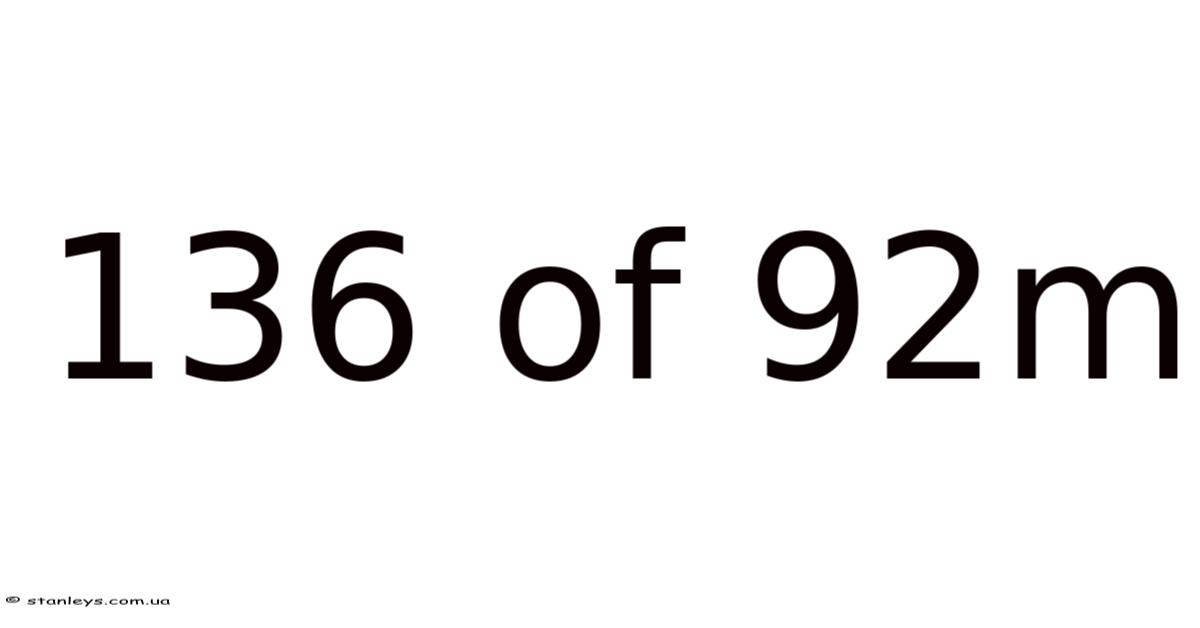
Decoding 136 of 92m: Understanding Ratios and Proportions in Everyday Life
Have you ever encountered a ratio like "136 of 92m" and felt a little lost? This seemingly simple expression represents a fundamental concept in mathematics – ratios and proportions. Understanding how to interpret and work with these ratios is crucial not just for academic success, but also for navigating many aspects of daily life, from cooking and budgeting to understanding statistics and scientific data. This article will delve deep into the meaning of "136 of 92m," explore the broader concept of ratios and proportions, and demonstrate their practical applications through real-world examples That alone is useful..
Worth pausing on this one.
What Does "136 of 92m" Mean?
The expression "136 of 92m" signifies a ratio. Here's the thing — it indicates that there are 136 units of something out of a total of 92 million units. This leads to the "m" likely represents "million. " To understand it fully, we need to clarify the context. Without knowing what these 136 units represent – be it people, objects, or data points – we can only analyze the ratio itself.
This ratio can be expressed in several ways:
- As a fraction: 136/92,000,000
- As a decimal: 0.000001478 (approximately)
- As a percentage: 0.0001478% (approximately)
Each representation provides a different perspective on the relative size of 136 compared to 92 million. The fraction shows the direct relationship, the decimal offers a precise numerical value, and the percentage allows for easier comparison and understanding within a familiar scale.
Easier said than done, but still worth knowing.
Let's imagine a context: Suppose 136 represents the number of defective products out of a total production of 92 million. Because of that, this allows us to quickly assess the product's quality control issues. A very small percentage of defects indicates a relatively high quality control efficiency The details matter here..
Ratios and Proportions: A Deeper Dive
Understanding ratios is the key to unlocking the meaning of "136 of 92m." A ratio is a comparison of two or more quantities. Here's the thing — it shows the relative size of one quantity compared to another. Ratios can be expressed using a colon (e.g., 1:2), as a fraction (e.g., 1/2), or using the word "to" (e.g., 1 to 2) No workaround needed..
A proportion is a statement that two ratios are equal. So proportions are often used to solve problems involving scaling or finding unknown quantities. Here's a good example: if we know the ratio of ingredients in a recipe and want to scale it up or down, we use proportions to maintain the same relative amounts.
Example: If a recipe calls for 2 cups of flour and 1 cup of sugar (a ratio of 2:1), and you want to double the recipe, you'd set up a proportion: 2/1 = x/2. Solving for x gives you 4 cups of flour, maintaining the 2:1 ratio.
Solving Problems with Ratios and Proportions
Let's explore how to solve problems involving ratios like "136 of 92m":
1. Simplifying the Ratio: The first step in analyzing 136/92,000,000 is simplification. While we can't significantly simplify this fraction by finding a common divisor, we can express it in its decimal or percentage form for easier interpretation.
2. Finding the Percentage: To find the percentage, we divide 136 by 92,000,000 and multiply by 100:
(136 / 92,000,000) * 100 ≈ 0.0001478%
This shows that 136 represents a minuscule fraction (approximately 0.00015%) of 92 million And that's really what it comes down to. Practical, not theoretical..
3. Applying Proportions: Let's say we wanted to find out how many defective products we'd expect in a smaller batch of 1 million products, maintaining the same defect rate. We can set up a proportion:
136/92,000,000 = x/1,000,000
Solving for x: x = (136 * 1,000,000) / 92,000,000 ≈ 1.48
This suggests we'd expect approximately 1.48 defective products in a batch of 1 million Not complicated — just consistent. That alone is useful..
Real-World Applications of Ratios and Proportions
Ratios and proportions are pervasive in various aspects of everyday life:
- Cooking: Recipes rely heavily on ratios. Doubling or halving a recipe requires understanding and adjusting proportions correctly.
- Finance: Budgeting and managing personal finances involve calculating ratios like savings-to-income ratio or debt-to-income ratio to assess financial health.
- Science: Scientists use ratios and proportions extensively in experiments and data analysis. Concentration of solutions, calculating reaction rates, and analyzing experimental results all involve these concepts.
- Mapping and Scale: Maps use ratios (scales) to represent large geographical areas on smaller pieces of paper. Understanding the scale allows one to accurately estimate distances and sizes.
- Engineering: Engineers work with ratios and proportions in structural design, calculating load-bearing capacities, and ensuring structural integrity.
- Statistics: Many statistical measures involve ratios or proportions, such as percentages, rates, and probabilities.
Understanding Different Types of Ratios
Beyond the simple ratio illustrated by "136 of 92m," several other ratio types exist:
- Part-to-Part Ratio: Compares one part of a whole to another part. Example: The ratio of boys to girls in a class.
- Part-to-Whole Ratio: Compares one part of a whole to the entire whole. Example: The ratio of red marbles to the total number of marbles in a bag.
- Rate: A ratio that compares two quantities with different units. Example: Speed (kilometers per hour), price per unit.
Frequently Asked Questions (FAQ)
Q1: How do I convert a ratio to a percentage?
To convert a ratio (a/b) to a percentage, divide 'a' by 'b' and multiply the result by 100 Simple, but easy to overlook..
Q2: What if the "m" in "92m" represents something other than million?
The interpretation changes based on the unit "m" represents. Without knowing the context, we can only work with the numerical ratio as presented Worth knowing..
Q3: How can I solve complex ratio problems?
Complex ratio problems often involve multiple ratios or proportions. Start by identifying the unknown quantity, set up appropriate equations (proportions), and solve for the unknown using algebraic techniques.
Conclusion
The seemingly simple expression "136 of 92m" opens a door to the vast and practical world of ratios and proportions. Understanding how to interpret and work with ratios is a vital skill applicable in numerous fields. By mastering these fundamental mathematical concepts, you'll gain a clearer perspective on data analysis, problem-solving, and decision-making in various aspects of your life. Now, whether you're following a recipe, analyzing statistical data, or making financial decisions, the ability to understand and apply ratios and proportions will enhance your capabilities and provide a more nuanced understanding of the world around you. Because of that, this knowledge empowers you to tackle complex problems, make informed choices, and appreciate the interconnectedness of mathematical concepts in everyday scenarios. Remember, the key lies in understanding the context, identifying the relevant quantities, and applying the appropriate mathematical techniques to extract meaningful insights Practical, not theoretical..
