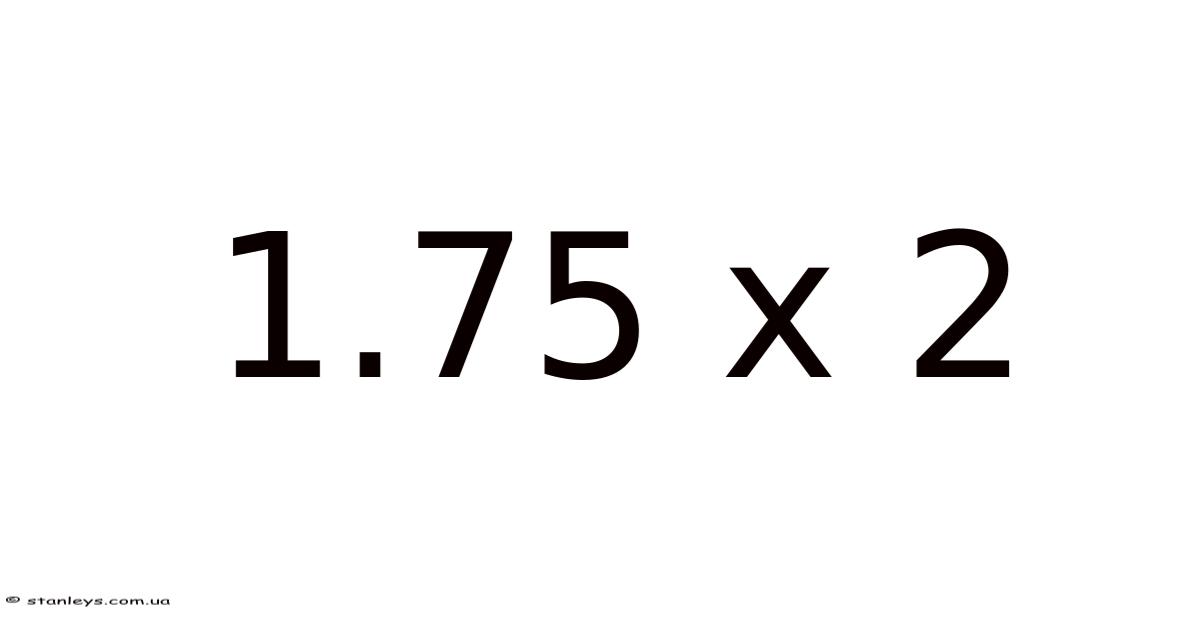
Decoding 1.75 x 2: Exploring Ratios, Proportions, and Real-World Applications
Understanding ratios and proportions is fundamental to many aspects of life, from cooking and construction to finance and scientific research. This article walks through the seemingly simple ratio of 1.75 x 2, exploring its mathematical significance, practical applications, and how it relates to broader concepts in mathematics and beyond. We'll unravel the intricacies of this ratio, demonstrating its versatility and providing a solid foundation for understanding similar proportional relationships.
Understanding Ratios and Proportions: A Quick Refresher
Before we dive into the specifics of 1.75 x 2, let's revisit the core concepts of ratios and proportions. A ratio is a comparison of two or more quantities. It can be expressed in several ways: using the colon (e.g., 1.75:2), as a fraction (e.Worth adding: g. Day to day, , 1. Think about it: 75/2), or using the word "to" (e. g.Plus, , 1. 75 to 2). On the flip side, a proportion, on the other hand, is a statement that two ratios are equal. Proportions are often used to solve for unknown quantities in a given ratio.
Take this case: if we have the proportion a/b = c/d, we can solve for any unknown variable if we know the values of the other three. This principle is crucial in numerous practical applications.
Analyzing the Ratio 1.75 x 2: Mathematical Significance
The ratio 1.To simplify this ratio, we can convert 1.75 x 2, or 1.75 = 7/4. That's why 75:2, represents a comparison between the two numbers. 75 to a fraction: 1.Because of this, the ratio becomes (7/4):2, which can be further simplified by multiplying both sides by 4 to eliminate the fraction: 7:8 No workaround needed..
This simplified ratio, 7:8, highlights the fundamental relationship between the two original numbers. Even so, it indicates that for every 7 units of one quantity, there are 8 units of another. This simple representation allows us to understand the proportional relationship more clearly. We can also express this as a fraction: 7/8 or a decimal: 0.875. In plain terms, 1.75 is 0.875 or 87.5% of 2.
People argue about this. Here's where I land on it.
This ratio can be scaled up or down proportionally. Each of these new ratios remains equivalent to the original 1.To give you an idea, if we multiply both parts of the ratio by 2, we get 14:16; multiplying by 3 yields 21:24, and so on. 75:2 or 7:8 ratio That alone is useful..
Real-World Applications of the 1.75:2 Ratio (or 7:8)
While seemingly simple, the 1.75:2 ratio, or its simplified form 7:8, finds applications in diverse fields:
-
Recipe Scaling: Imagine a recipe that calls for 1.75 cups of flour and 2 cups of water. Using the ratio, you can easily scale the recipe up or down. If you want to double the recipe, you would use 3.5 cups of flour and 4 cups of water. Conversely, if you want to halve it, you would use 0.875 cups of flour and 1 cup of water Which is the point..
-
Construction and Engineering: In construction, precise measurements are crucial. The ratio might represent the proportions of different materials in a mixture, like concrete or mortar. Understanding the ratio ensures the correct proportions are maintained for optimal strength and durability.
-
Finance and Investment: Ratios are frequently used in financial analysis to assess the performance of companies or investments. As an example, the ratio could represent the proportion of debt to equity in a company's capital structure, offering insights into its financial risk.
-
Science and Research: In scientific experiments, precise ratios are often essential. Take this case: in chemistry, the ratio of reactants in a chemical reaction must be carefully controlled to achieve the desired outcome. In biology, ratios might represent the proportions of different components in a cell or organism.
-
Graphic Design and Art: Proportions play a key role in creating aesthetically pleasing designs. The golden ratio (approximately 1.618) is a famous example, but other ratios, including 7:8, can be used to create balanced and harmonious compositions in artwork, design layouts, and photography Nothing fancy..
-
Everyday Life: The ratio might even show up unexpectedly in everyday situations. Perhaps you're comparing the price of two different sizes of the same product and need to determine which is a better value based on the unit price.
Extending the Concept: Exploring Similar Proportions
The understanding of the 1.75:2 ratio can be extended to explore similar proportional relationships. Understanding this ratio helps us grasp the underlying principles of proportion and its application to solve a range of problems involving ratios Small thing, real impact..
- 1.75:3.5: Doubling the second term maintains the proportionality. This could represent scenarios where the second quantity is double the first.
- 3.5:4: This ratio is equivalent to 7:8, showing that the proportional relationship holds even with larger numbers.
- 0.875:1: This is the decimal equivalent, highlighting the flexibility of expressing proportions in various forms.
Exploring these similar proportions reinforces the idea that the fundamental proportional relationship remains constant, regardless of the specific numerical values used It's one of those things that adds up..
Solving Problems Using Proportions: A Practical Example
Let's illustrate the practical application of proportions using an example: A recipe requires 1.75 cups of sugar for every 2 cups of flour. If you want to make a larger batch using 5 cups of flour, how much sugar do you need?
The official docs gloss over this. That's a mistake.
We can set up a proportion:
1.75 cups sugar / 2 cups flour = x cups sugar / 5 cups flour
To solve for x, we cross-multiply:
2x = 1.75 * 5
2x = 8.75
x = 8.75 / 2
x = 4.375
Which means, you would need 4.375 cups of sugar for 5 cups of flour Small thing, real impact..
Frequently Asked Questions (FAQ)
-
Q: Can the ratio 1.75:2 be expressed as a percentage?
- A: Yes, it can. 1.75 is 87.5% of 2 (1.75/2 * 100 = 87.5%).
-
Q: Is the ratio 1.75:2 the same as 2:1.75?
- A: No, these are inverse ratios. They represent different proportional relationships.
-
Q: What are some other examples of ratios used in everyday life?
- A: Many exist! The gear ratio in a bicycle, the aspect ratio of a screen, the fuel-to-air ratio in an engine, and the ratio of ingredients in a recipe are just a few examples.
-
Q: How can I simplify complex ratios?
- A: Start by converting decimals to fractions and then find the greatest common divisor (GCD) of the numerator and denominator. Divide both by the GCD to get the simplest form.
Conclusion: The Power of Proportional Reasoning
The seemingly simple ratio of 1.By mastering this fundamental concept, you equip yourself with a versatile skill set applicable to various aspects of life and problem-solving. 75 x 2, once simplified to 7:8, reveals a powerful tool for understanding and applying proportional reasoning. The ability to recognize, simplify, and apply ratios expands your mathematical understanding and empowers you to tackle complex challenges with confidence and precision. From scaling recipes and constructing buildings to conducting scientific experiments and analyzing financial data, the ability to work with ratios and proportions is essential across numerous disciplines. Remember that understanding the underlying principles is more crucial than memorizing specific ratios – the ability to apply these principles to new situations is the key to true mastery Not complicated — just consistent. No workaround needed..
